
The Quiet Frustration of Your First Mortgage Statement
I still remember staring at my very first mortgage bill, feeling totally confused and a little sick to my stomach. I assumed my huge monthly payment was actually paying off my house, but my jaw dropped when I saw that almost all of my money went straight to the bank's interest. It was a harsh wake-up call, but that exact moment forced me to figure out how this system really works so I could fight back.
You finally bought your dream home. You signed the endless mountain of paperwork, took the keys, and moved in.
A few weeks later, your very first mortgage statement arrives in the mail. You write a check for a large amount of money, perhaps two thousand dollars.
You feel a deep sense of pride as you send that money away. You assume your massive loan balance has dropped by that exact amount.
A month passes, and you look at your updated loan balance online. Your heart sinks into your stomach.
Your loan balance barely moved at all. Out of your two-thousand-dollar payment, only a tiny sliver went toward paying off your actual house.
The rest of your hard-earned money was swallowed up by interest charges. You check the numbers again, thinking there must be a mistake.
Unfortunately, there is no mistake. This is the cold, hard reality of how most home loans are designed.
Many new homeowners experience a quiet panic during these first few months. They feel like they are running on a treadmill, spending thousands of dollars but going nowhere.
It feels like the financial system is rigged against you. You wonder if you will ever truly own your home or if you will be paying interest forever.
Understanding this process is the first step to taking back control of your financial life. Once you understand the mechanics of your loan, you can make smarter choices to beat the bank at its own game.
Decoding the Math Behind Your Monthly Payments
To stop worrying about your loan balance, you need to understand how amortization works. The word amortization sounds complex, but its origin reveals its simple meaning.
It comes from an old Latin word that means "to kill off." An amortization schedule is simply a plan to slowly kill off your debt over a set period of time.
Every month you make a payment, a small part of your debt dies. Let us break down exactly how this process works.
Distinguishing the Principal from the Interest
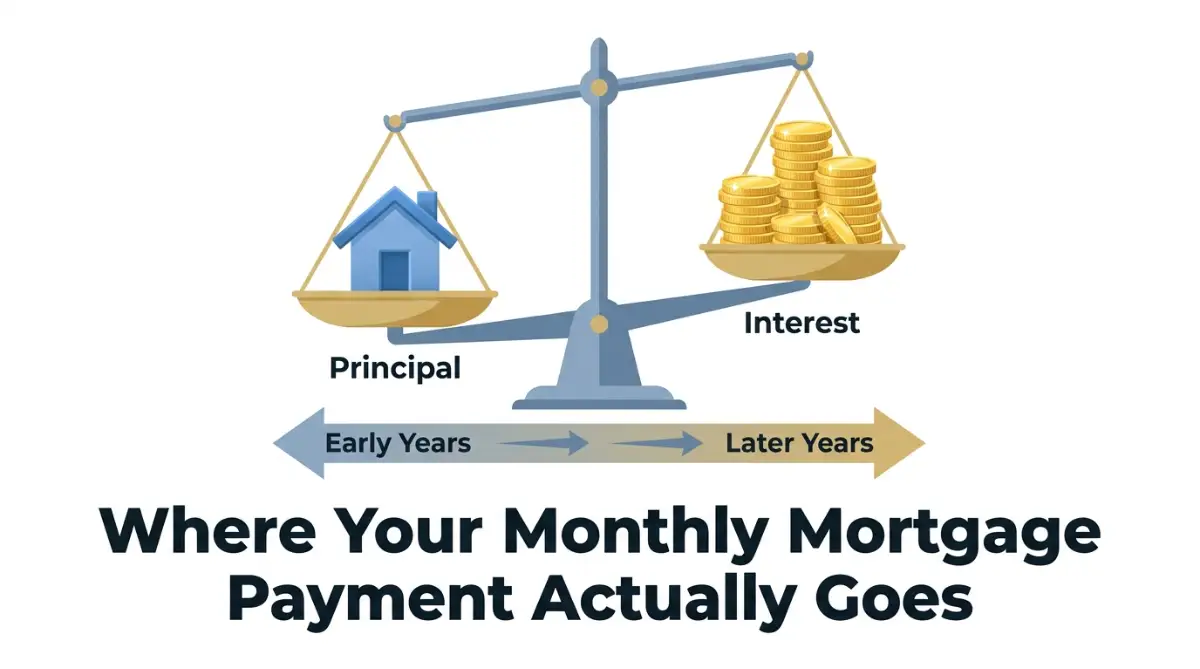
Your monthly mortgage payment is not a single bucket of money. Instead, it is divided into two distinct parts every single month.
The first part is the principal. This is the actual amount of money you borrowed from the bank to buy your property.
The second part is the interest. This is the fee the bank charges you for the privilege of using their money.
When you make your payment, the bank does not split it down the middle. Instead, they use a specific mathematical formula to decide who gets paid first.
Why the Bank Collects Its Cut First
The bank always makes sure it gets paid its interest before you get to pay down your debt. This is why your early payments seem to do almost nothing to your loan balance.
Every month, the bank calculates interest based on how much money you still owe them. Because your loan balance is at its absolute highest in the beginning, the interest charge is also at its highest.
Let us look at a simple example to make this easy to see. Imagine you have a thirty-year fixed-rate mortgage for $300,000 with an interest rate of 6%.
Your fixed monthly payment for principal and interest will be exactly $1,798.65 every month.
In your very first month, the bank calculates your interest. They take your $300,000 balance and multiply it by your interest rate, then divide it by twelve months.
The Slow Climb of Home Equity
As you continue to make payments, a slow and steady change begins to happen. Because you paid off a tiny bit of the principal in month one, your balance in month two is slightly lower.
When the bank calculates the interest for month two, they calculate it based on $299,701.35 instead of the full $300,000.
Because the balance is lower, the interest charge drops by a few cents. That means a few more cents of your payment can go toward the principal.
This cycle repeats every single month. Over time, the amount going to interest shrinks, and the amount going to principal grows.
This shifting balance is how you build equity in your home. Equity is the portion of the property that you actually own free and clear.
In the beginning, your equity grows at the speed of a snail. But as the years go by, the process speeds up dramatically.
If you are a visual learner, watch this quick video below to see exactly how these loan numbers shift over time, and then keep reading to discover my favorite tricks for saving thousands!
How a Clean Credit History Lowers Your Starting Interest Rate
Your interest rate is the single biggest factor that determines how much interest is front-loaded into your amortization schedule. A higher rate means you will spend years paying off the bank before you make a dent in your actual debt.
This is why your financial health before buying a home is so important. Lenders use your credit score to determine your interest rate.
If your credit report has errors or old mistakes, you will be hit with a much higher rate. Taking the time to prepare your finances can save you a fortune.
For example, cleaning up errors on your credit history before you apply for a loan can help you qualify for the lowest possible rate. Even a half-percent difference in your rate can save you tens of thousands of dollars over the life of your loan.
A lower starting rate means more of your very first payment goes toward your principal instead of the bank's profit. It sets up your entire amortization schedule for success.
A Visual Guide to Your Amortization Journey
To help you see this path clearly, let us look at a simple breakdown of our $300,000 mortgage at 6% interest over thirty years. This table shows how the payment structure shifts over time.
As you can see, it takes fifteen years just to get to a point where your principal payment is almost equal to your interest payment.
But once you cross that middle point, your progress accelerates. By the final years, almost your entire payment goes directly into your own pocket by building your equity.
If you want to play with these numbers yourself, you can use the Consumer Financial Protection Bureau mortgage tools to see how different interest rates affect your monthly payments[1]. Seeing the math in front of you takes away the mystery of home loans.
Clever Strategies to Beat the Bank and Save Thousands
Now that you know how the math works, you do not have to accept the slow thirty-year timeline. You have the power to alter your amortization schedule.
By making small, strategic adjustments, you can shave years off your loan and save a fortune in interest. Let us explore some of the most effective ways to do this.
The Power of Making Extra Principal Payments
Early on, I made the silly mistake of just adding extra money to my check without telling the bank exactly where that cash should go. I quickly realized they were applying it to next month's normal payment instead of my actual debt, so now I always double-check that my extra money is marked strictly for the principal.
The absolute fastest way to hack your amortization schedule is by making extra principal payments. When you send extra money to your lender and specify that it should go directly to the principal, amazing things happen.
This extra money does not get split between principal and interest. Because the interest for that month has already been covered by your regular payment, 100% of your extra payment goes directly to reducing your outstanding loan balance.
Let us go back to our $300,000 mortgage at 6% interest. Your regular payment is $1,798.65.
Imagine you decide to pay an extra $100.00 every single month, starting from your very first payment.
This small extra payment seems minor, but its long-term impact is massive. By paying just $100.00 extra each month, you will pay off your thirty-year mortgage more than four years early.
Even better, you will save over $48,000.00 in total interest payments. That is forty-eight thousand dollars that stays in your bank account instead of going to the lender.
You do not need a massive fortune to make this work. Even an extra twenty or fifty dollars a month will make a noticeable difference over time.
The Clever Bi-Weekly Payment Method
If you do not want to think about adding extra money to your budget every month, there is a simple automated trick you can use. This is called the bi-weekly payment plan.
Instead of making one full mortgage payment every month, you pay half of your monthly payment every two weeks.
Because there are fifty-two weeks in a year, you will make twenty-six half-payments. This is equal to thirteen full monthly payments instead of the usual twelve.
By making this one extra payment each year, you quietly chip away at your principal.
This simple shift can shave about four to five years off a thirty-year mortgage. It also saves you tens of thousands of dollars in interest.
Most mortgage lenders allow you to set up this schedule automatically through their online portals. It is a set-it-and-forget-it strategy that builds your wealth in the background of your life.
Starting Your Financial Journey with Less Debt Burden
To have the extra cash to throw at your mortgage principal, you need to look at your overall financial picture. If you are weighed down by other high-interest debts, it can be hard to find even fifty dollars extra each month.
Many people struggle to balance their housing payments with student loans and other obligations. Taking a step back to look at your other debts is a great way to open up monthly cash flow.
For instance, finding a way to get relief from your student loans can change your entire budget. If you are struggling with student debt, you can learn about managing educational loan debt to see if you qualify for programs that can lower your monthly payments.
Reducing those other monthly bills allows you to redirect that cash straight into your mortgage. This helps you build equity in your home much faster.

Dangerous Amortization Traps to Avoid
While hacking your amortization schedule is highly effective, there are some common mistakes that can ruin your progress. Many well-meaning homeowners fall into these traps without even realizing it.
Forgetting to Specify "Principal Only" on Extra Payments
The most common mistake people make is sending extra money to their lender without clear instructions. If you just add an extra hundred dollars to your monthly check, the bank might not apply it to your principal balance.
Instead, many lenders will apply that extra money to your next month's regular payment. This is called "prepaying" your payment.
This does not reduce your outstanding principal balance today. It does not save you any interest.
Always check your lender's online portal or paper payment slip. Make sure there is a box checked or a note written that says "Apply Extra to Principal Only."
Verify your loan statements every month to make sure the bank is applying your extra funds correctly. Do not let them hold your money without reducing your debt.
Refinancing Back Into a Thirty-Year Term
Refinancing your mortgage to a lower interest rate can be a fantastic way to save money. However, you must be careful about the term of the new loan.
Imagine you have been paying off your thirty-year mortgage for ten years. You have made real progress, and your balance is finally starting to drop faster.
Suddenly, interest rates drop, and you decide to refinance to save money on your monthly payment.
If you refinance into a brand-new thirty-year loan, you are resetting your amortization schedule back to day one.
Even if your monthly payment is lower, you have just signed up for another thirty years of interest-heavy payments. You have erased ten years of hard work.
If you refinance after ten years of payments, try to refinance into a twenty-year or fifteen-year loan instead. This keeps your progress moving forward without resetting the interest clock.
If you are looking at different ways to manage your overall debt portfolio, it is always wise to compare all your options. For example, understanding debt consolidation options can help you see how different loan structures impact your long-term wealth building.
Not Securing the Best Rate from the Start
Some buyers are so excited to get a home that they accept the very first loan offer they receive. They do not realize how much a slightly higher rate will hurt them on their amortization schedule.
If you have a lower credit score, you might think you have to accept a high-interest rate. But there are ways to lower your rate before you sign the paperwork.
One highly effective option is to bring on a trusted family member to help you secure a better rate. You can read more about using a co-signer for better rates to see how this simple step can dramatically lower your starting interest charges.
A lower rate from day one ensures that your amortization schedule is working for you, not against you, from the very first payment.
Your Personal Action Plan for Mortgage Freedom
Understanding your amortization schedule is like having a map of a long road trip. It might look like a very long journey, but knowing exactly where the turns are makes it much easier to navigate.
You do not have to accept a thirty-year sentence of high-interest payments. By taking action today, you can change the math and build real wealth.
Here is a simple three-step checklist to start your journey toward mortgage freedom:
- Step 1: Get Your Schedule. Log into your mortgage portal and download your full amortization schedule. Print it out or save it to your computer so you can see the math for yourself.
- Step 2: Start Small. Look at your monthly budget and find just fifty or one hundred dollars that you can cut. Set up an automatic monthly payment of that amount, marked strictly as "Principal Only."
- Step 3: Track Your Progress. Every few months, look at your loan statement. Celebrate as you watch your remaining balance drop faster than the original schedule predicted.
Your home is one of the biggest investments you will ever make in your life. By understanding the math behind your payments, you protect that investment and secure your financial future.
Take that first step today, and start building the real equity you deserve.
Looking back, taking charge of my mortgage numbers was one of the best financial choices I ever made for my family. You do not need to be a math genius to do this, so just pick one small strategy today and start watching your own debt melt away!
Disclaimer:This article is for informational and educational purposes only. It does not constitute formal financial, legal, or real estate advice. Mortgage rules, interest calculations, and loan terms can vary widely based on your location, lender, and personal financial situation. Always consult with a licensed mortgage professional or certified financial planner before making major financial decisions, signing loan agreements, or changing your payment structures.