The Hidden Stress of Choosing the Right Loan Option
I remember staring at a massive stack of loan paperwork, feeling completely lost and stupid. Picking a loan rate should not feel like guessing lottery numbers, right? If you are stressed out trying to figure out if you should lock in a fixed rate or take a chance on a variable one, you are in the exact right place. I am going to make this ridiculously simple for you so you can finally relax and make a smart choice.
Here is why finding the right loan path feels so incredibly hard:
- Many online financial articles use complex jargon that is almost impossible for everyday people to understand easily.
- Conflicting advice from friends and family members often leaves you feeling more confused than when you started your search.
- Some traditional banks push specific options that benefit their own profit margins rather than your unique personal budget.
- The fear of unexpected market rate hikes makes you hesitate, causing you to miss out on good borrowing opportunities.
This constant financial uncertainty takes a heavy toll on your mental well-being:
- You may experience ongoing anxiety whenever you think about your long-term monthly financial obligations and household bills.
- Your confidence in making big life decisions can drop, leaving you feeling stuck and completely helpless.
- The stress can slowly creep into your personal relationships, causing tense discussions about family savings and daily expenses.
- You feel like you are gambling with your hard-earned cash instead of making a safe, logical choice.
Let us look at a simple everyday example. Meet Sarah, a hard-working school teacher who wanted to consolidate some high-interest card debt. She spent weeks searching the web for a clear, simple answer on loan interest rates. Instead of clarity, she found a wall of confusing terms and pushy bank ads.
We believe you deserve a better, more transparent way to manage your borrowing. You should feel confident and secure when you sign a loan contract. Let us break down this topic together so you can take back control of your financial path.

What You Will Learn in the Next 3 Minutes:
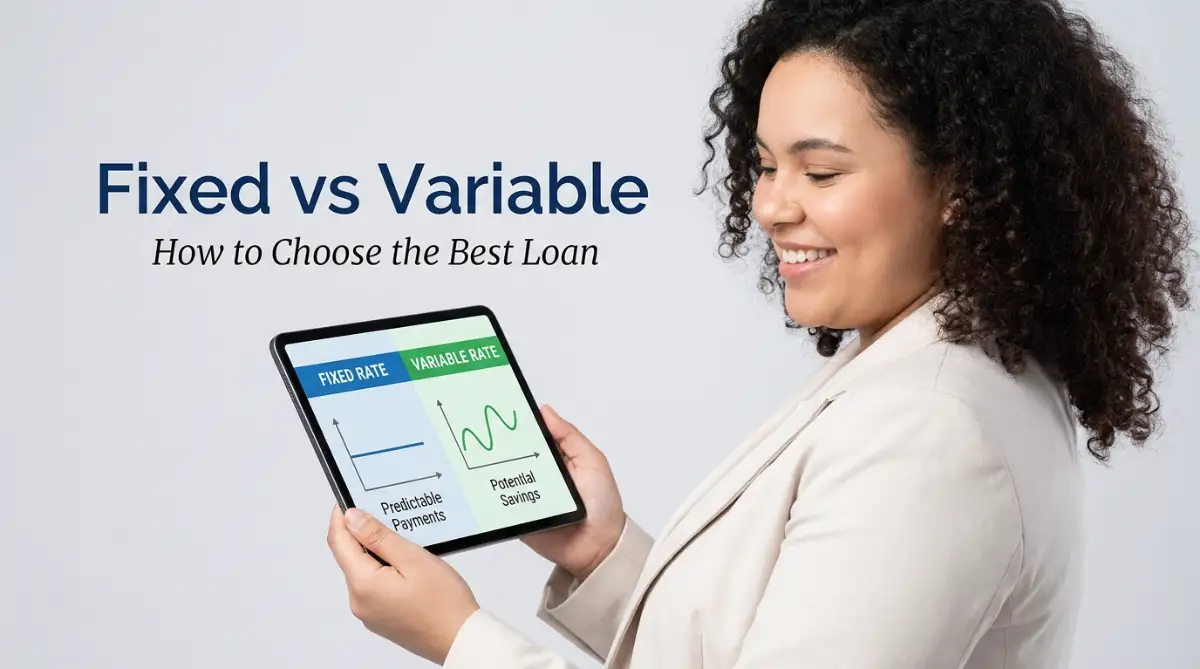
- Fixed Rates: Your monthly bill stays exactly the same, giving you 100% peace of mind.
- Variable Rates: Starts cheaper, but your bill can go up if the economy changes.
- The Golden Rule: Always check the "Lifetime Cap" before you agree to a variable loan.
- Hidden Traps: Why the lowest starting interest rate is not always the cheapest option.
Your Simple Guide to Understanding Fixed and Variable Rates
Choosing a loan does not have to feel like a high-stakes guessing game. By understanding how interest works, you can pick an option that fits your pocketbook perfectly. Let us explore the basic building blocks of these two popular rate options.

Introductory Text to place just above the embedded video:
Before we break down the math, watch this quick video that perfectly explains how interest rates actually work in plain, everyday language. It will make the rest of this guide so much easier for you to follow!
Demystifying the Fixed Rate Loan Option
A fixed rate loan is a borrowing agreement where your interest rate stays exactly the same for the entire life of the loan. This means your first monthly payment will look identical to your very last monthly payment. There are absolutely no surprises, no sudden increases, and no unexpected changes.
Think of a fixed rate like buying a season pass to a local theme park. You pay one set price upfront, and you can visit as much as you want without worrying about ticket prices rising later. This stability makes it incredibly easy to plan your household expenses. You can read more about how a fixed interest rate works from trusted financial experts to build your confidence.
If you are someone who loves order, spreadsheets, and predictable monthly bills, this option is built for you. You will always know exactly how much cash is leaving your bank account each month. This predictability protects you from sudden economic shifts and rising market rates.
Unpacking the Variable Rate Option
A variable rate loan is a borrowing agreement where your interest rate can move up or down over time. These changes are usually tied to a benchmark market index set by central banking systems. If the market index drops, your monthly payment goes down; if it rises, your payment goes up.
Think of a variable rate like paying for electricity based on real-time market demand. During cool months, your bill might be incredibly cheap and save you a lot of money. However, during a hot summer, the price can spike and demand a much higher payment. The Consumer Financial Protection Bureau offers helpful tools to study how these shifting interest rates can affect your household budget.
The primary benefit of a variable rate is that it often starts out lower than a fixed rate. This initial discount can save you money right away. However, you must be prepared to handle the risk of rates climbing higher in the future.
Quick Myth vs. Fact Check
- The Myth: Variable rates are always a sneaky trap set by greedy banks.
- The Truth: Not exactly! If you plan to pay off your debt super fast (like within a year or two), a variable rate can actually save you a good chunk of money before the market even has a chance to change.
Assessing Your Personal Budget and Risk Comfort
Before choosing a path, you need to take a close, honest look at your personal finances. Ask yourself how much risk you can reasonably handle without feeling stressed. If your monthly income is strictly limited, a sudden rate hike could put your family in a difficult spot.
For instance, if your budget is already tight, a thirty-dollar monthly increase might cause serious stress. In this scenario, paying a slightly higher initial fixed rate is worth the absolute peace of mind it provides. You are essentially paying a small premium for financial insurance.
On the other hand, if you have a healthy savings cushion, you might decide to take a calculated risk. If you plan to pay off your debt very quickly, a variable rate can help you save on interest during those first few months. It all comes down to your personal goals and your unique financial comfort zone.
Expert Strategies for Choosing Your Best Loan Rate
Now that we understand the basics, we can look at some advanced ways to make a smart borrowing decision. Understanding these helper strategies will keep you ahead of the game.
Analyzing the Current Economic Trend
You do not need an advanced degree in economics to make a smart decision about interest rates. You simply need to pay attention to the general direction of the financial market. If the central bank is actively raising rates to fight inflation, locking in a fixed rate is often the smartest move.
On the flip side, if the central bank is cutting rates to boost the economy, a variable rate can work in your favor. As the market drops, your monthly payments will naturally decrease without you having to refinance. Understanding these patterns helps you borrow with confidence from any major financial institution.
Always ask your lender about the specific index they use to calculate their variable rates. Some lenders use indexes that react very slowly to market changes, while others change overnight. Knowing this detail helps you avoid unpleasant surprises down the road.
Calculating the Break-Even Point of Your Loan
Let us look at a practical scenario to see how this works in real life. Imagine Michael needs a loan and is offered two different options from his local bank. The first option is a fixed rate at six percent, and the second is a variable rate starting at four percent.
The variable rate is initially cheaper, saving him money every month right from the start. However, if the market rate rises by three percent next year, his variable rate will jump to seven percent. Now, his variable loan is more expensive than the fixed option he turned down.
To make a smart choice, Michael needs to calculate how long he plans to keep the loan. If he plans to pay off the entire balance within one year, the variable rate is the clear winner. The rates are unlikely to rise fast enough in twelve months to erase his initial savings. If you want to use these smart calculations to your advantage, you can learn to borrow money without collateral using safe, modern lending strategies.
Protecting Your Wallet with Rate Caps
If you do choose a variable rate, you must check the loan agreement for interest rate caps. A rate cap is a legal limit on how high your interest rate can actually go. These caps act as a safety net to protect you from extreme market spikes.
There are usually two types of caps in a standard contract:
- Periodic Caps: This limits how much the interest rate can change during a single adjustment period, like once a year.
- Lifetime Caps: This sets an absolute ceiling on the interest rate, meaning your rate can never go above this number, no matter what happens to the economy.
Never sign a variable rate agreement that does not include a clear, reasonable lifetime cap. Without a cap, you are writing a blank check to your lender. Knowing these rules allows you to secure bank loans without pledges while keeping your monthly payments safe.
Ask Yourself: What is my Breaking Point?
Before you sign any paper, I want you to do this exact math:
- Find the absolute highest possible rate listed in your contract (the lifetime cap).
- Calculate your monthly bill using that maximum number.
- Ask yourself: If my bill hits this exact amount next year, can I still buy groceries and pay rent without panicking?
- If your honest answer is no, stick to the fixed rate. The extra stress just is not worth it!
To make these calculations easier, you can use some of the top free AI tools that save hours of work to analyze your payment schedules. Using technology can help you map out your future expenses with incredible accuracy.

Costly Pitfalls to Avoid When Selecting a Loan Rate
When you are applying for a loan, it is easy to make simple mistakes that cost you thousands of dollars. Let us look at the most common pitfalls so you can avoid them completely.
Focus Only on the Starting Interest Rate
The lowest number on the page is always the most attractive, but it can be highly misleading. Many lenders offer incredibly low "teaser" rates on variable loans to attract new customers. These low rates are temporary and will naturally rise after a few months.
If you budget your life based solely on that temporary starting rate, you will face a rude awakening. Always calculate your monthly payments using the maximum possible rate to ensure you can still afford it.
Ignoring the Extra Fees and Fine Print
An interest rate is only one part of the total cost of borrowing money. Many loans come with hidden costs like origination fees, processing fees, and prepayment penalties. A prepayment penalty is a fee you pay simply for clearing your debt early.
If a loan has a low interest rate but high administrative fees, it might actually cost more than a higher-rate loan. Always ask your lender for the Annual Percentage Rate (APR). The APR represents the true yearly cost of the loan, including all fees and interest.

Failing to Compare Offers from Multiple Lenders
Many people simply accept the first loan offer they receive from their primary bank. I actually made this exact mistake a few years ago when I just accepted whatever my local bank offered me without asking any questions. Later, I realized I could have saved hundreds of dollars a year if I had just taken five extra minutes to check online offers. My biggest lesson is that loyalty to one bank rarely pays off, so you should always shop around first.This habit can cost you a significant amount of money over time. Different financial institutions target different types of borrowers and offer widely different rates.
Spend a few hours shopping around and getting quotes from online lenders, credit unions, and traditional banks. Even a tiny half-percent difference in your interest rate can save you hundreds of dollars over the years.
Overestimating Your Future Income Stability
It is easy to assume that your income will always stay the same or increase in the coming years. However, unexpected life events like job losses, medical emergencies, or economic downturns can happen to anyone.
If you take on a variable rate loan assuming you will easily handle any future rate increases, you are taking a major gamble. Always build a safety buffer into your calculations. If a rate hike would make it impossible to pay your mortgage or rent, stick to a fixed rate.
Choosing the Wrong Loan Term Length
The length of your loan has a massive impact on how much interest you will pay overall. A longer loan term will give you lower monthly payments, which looks very attractive on paper. However, it also means you will be paying interest for a much longer period.
You might end up paying double the actual cost of your purchase in interest alone. Try to choose the shortest loan term that you can comfortably afford to minimize your total borrowing costs.
Taking the Next Step Toward Your Financial Freedom
Choosing between a fixed rate and a variable rate loan is all about balancing predictability with potential savings. There is no single correct answer that works for every single person. Your decision should depend entirely on your current budget, your future income, and your comfort with risk.
Take a deep breath and review your monthly income and expenses today. Write down your numbers, use online calculators, and talk to trusted advisors before signing any agreement. You have the knowledge and the power to make a smart, confident decision for your financial future.
Start taking control of your financial journey right now by comparing your local options. With a clear plan and the right information,Looking back, taking control of my own loan choices was the single best thing I ever did for my mental health and my wallet. I promise that once you take that first step to compare your options, that heavy weight on your chest will finally disappear. You have got this, so go out there and claim the financial peace you completely deserve! you can secure a loan that helps you reach your goals without stressing your wallet. Your path to a secure, stress-free financial life starts with the very next step you take today.