
The True Cost of Borrowing: Why High Interest Fees Are Draining Your Bank Account
Look, I get it. Opening your bank app and seeing that loan balance barely move—even after making payments for months—makes you want to throw your phone across the room. You aren't bad at math; the financial system is literally built to keep you on the hook for as long as possible. Today, we are going to fix that. I am going to show you a few simple, no-nonsense tricks to flip the script on your bank, pay off your balance faster, and actually keep your hard-earned money in your own pocket.
Think back to the day your loan was approved. You probably felt a massive wave of relief and excitement.
But as the months rolled by, that initial excitement slowly turned into stress. Every single month, you write a check or see money leave your account, only to realize your balance barely moves.
It feels like you are stuck on a treadmill that never stops. You work incredibly hard, yet most of your money goes straight into the pocket of the bank.
- Borrowers often trust complicated bank terms without realizing how much money they lose to compound interest.
- Common financial advice online is often confusing, leaving you unsure of which step to take first.
- Many people do not know that they have the power to negotiate their interest rates or change their payment plans.
- Borrowers frequently fall for tricky refinancing offers that actually cost them more money in the long run.
- Carrying a large debt load creates a constant, quiet stress that follows you from morning until night.
- Watching your hard work benefit bank profits instead of your family can make you feel helpless and defeated.
- The fear of missing a payment and ruining your credit score damages your confidence about the future.
- You might feel trapped in a job you dislike because you cannot afford to take risks while paying off a loan.
- This ongoing financial worry drains your daily mental energy, making it hard to focus on your personal happiness.
Let us look at a simple example to show how this works. Imagine you borrow $30,000 for a car or home project.
The interest rate might look small on paper, maybe just a single digit. But over five or ten years, that small percentage grows into a giant financial monster.
You end up paying back thousands of dollars more than you originally borrowed. This is not just numbers on a screen; this is real money that could pay for your child's education or a peaceful vacation.
Sadly, the traditional banking system is designed to keep you paying interest for as long as possible. The longer you take to pay, the more profit the bank makes from your labor.
Understanding this reality is the first step toward taking back control of your financial life. We need to stop viewing interest as a normal monthly bill and start seeing it as a leak we must plug.
Money Myth vs. Fact:
- The Myth: Paying a few extra dollars a month won't make a dent in my loan.
- The Fact: Even an extra $20 marked strictly for your principal can knock months off your repayment timeline and save you hundreds in the long run. It is all about how you apply the payment.
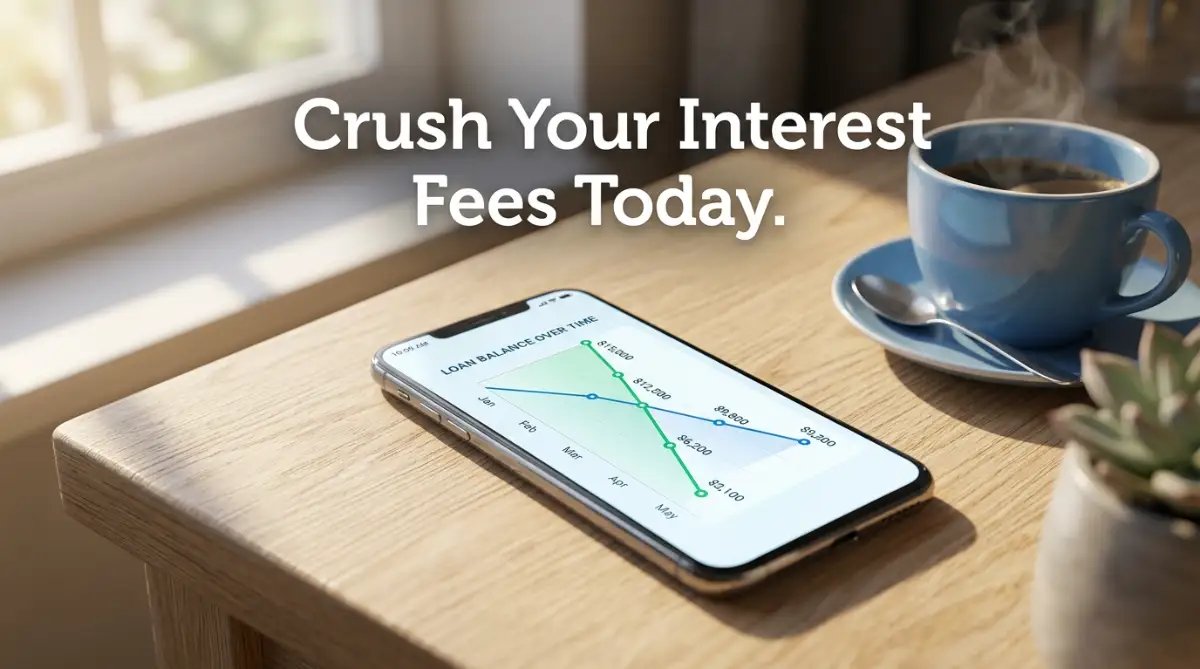
What You Will Take Away from This Guide:
- How splitting your monthly bill into two parts cheats the math in your favor.
- The exact words to tell your bank so your extra money actually pays down your debt.
- Why finding your highest interest rate first is the smartest move you can make today.
- Simple habits to put your savings on autopilot without feeling broke.
Switch to Bi-Weekly Payments to Hack Your Loan Term
Most people pay their bills once a month, which means making 12 payments a year. If you split your monthly payment in half and pay every two weeks instead, you will make 26 half-payments.
This adds up to 13 full payments a year instead of 12. You will make an extra full payment each year without even noticing a difference in your lifestyle.
This extra payment goes straight toward reducing your principal balance. Because your principal goes down faster, the bank has less balance to calculate interest on.
Let us look at a real-life scenario to see how this works. Imagine a borrower named Sarah who has a student loan of $25,000.
She was paying $300 every month on the first day of the month. She decided to change her plan to pay $150 every two weeks instead.
By making this small shift, she paid an extra $300 each year without feeling any financial pain. This simple trick shaved nearly a year off her loan term and saved her hundreds of dollars in interest fees.
Quick Breakdown: Standard vs. Bi-Weekly Payments
- Monthly Plan: You make 1 payment per month (12 payments a year).
- Bi-Weekly Plan: You pay half your bill every two weeks (26 half-payments = 13 full payments a year).
- The Result: You sneak in a whole extra payment every single year without wrecking your budget, dropping your principal faster than the bank expects!
To set this up, call your loan servicer and ask if they accept bi-weekly payments. Most banks can automate this process for you easily.

Target the Principal Balance Directly with Extra Payments
When you make a standard payment, a large portion of that money goes toward paying the interest fees first. Only the remaining small amount actually reduces the actual debt you owe.
To beat this system, you need to send extra money marked specifically for the principal. Even a tiny amount of extra cash can make a massive difference over several years.
Let us introduce Mark, who bought a home and had a 30-year mortgage. He set up a budget where he saved money on his weekly groceries by buying store brands.
He used that saved cash, which was about $80 a month, to make extra principal payments. Within a few years, Mark saw his loan balance dropping much faster than his neighbors' balances.
You can find extra cash by reviewing your monthly spending. Cutting out one unused subscription or eating out less can free up $50 to $100 a month.
Before you send this extra cash, always contact your bank. I used to make a big mistake by just sending extra money to the bank whenever I had a little spare cash. I thought they would automatically use it to lower my debt, but I later found out they were just applying it to my next month’s bill instead of the principal! My big tip for you is to always double-check your receipt; once I started making sure my extra payments were marked as "Principal Only," I saw my balance finally start to drop much faster.Make sure they apply the extra money to your principal balance, not your next monthly payment.
Some banks automatically put extra money toward future payments, which does not save you any interest. You must be clear and direct with your instructions.
Refinance Wisely to Grab a Much Lower Rate
If interest rates have dropped since you took out your loan, refinancing is a fantastic option. It is also a great path if your credit score has improved over the last few years.
Refinancing simply means replacing your current high-interest loan with a brand-new, low-interest loan. This move can instantly lower your monthly payment and reduce the total interest you will pay.
Let us look at Jessica, who had a high-interest car loan at 9% interest. After a year of making payments on time, her credit score improved significantly.
She decided to talk to a local credit union about refinancing her car loan. They offered her a new loan at 4.5% interest, which was half her original rate.
Her monthly payment dropped, and she saved over $2,000 in total interest over the remaining three years of the loan. She used those savings to build her emergency fund.
However, you must look closely at the closing costs and fees before signing any refinancing papers. If the fees to refinance are too high, it might take too long to break even on your savings.
Another smart trick is to refinance into a shorter loan term. For example, you can switch from a 30-year mortgage to a 15-year mortgage.
While your monthly payment might go up slightly, you will save a massive fortune on total interest fees over the life of the loan. Always run the numbers carefully to see what fits your budget.
How a Single Percentage Point Changes Your Financial Future
Many people believe that a small 1% change in an interest rate is not worth the effort. This is a common mistake that costs borrowers thousands of dollars over time.
Let us use a simple calculation to show the true impact of a 1% rate reduction. Imagine you have a $150,000 loan with a 30-year term at a 6% interest rate.
Over the life of that loan, you will pay about $173,000 in interest alone. That means you pay back more than double what you originally borrowed.
Now, imagine you lower that rate to just 5% through refinancing or negotiating with your lender. Your total interest fees drop to roughly $139,000.
By lowering your interest rate by just 1%, you save $34,000 in hard cash. That is money that stays in your pocket instead of going into bank profits.
This is why tracking interest rates and maintaining a great credit score is so rewarding. You are keeping your own money where it belongs.
The Power of Compound Interest in Reverse
Compound interest is often called a magic tool when you are saving money in a bank account. But when you are paying off a loan, compound interest works against you like an enemy.
Every day your loan sits unpaid, interest builds on top of interest. By making extra principal payments, you stop this snowball effect in its tracks.
Think of it like clearing snow from your driveway. If you clear it while it is fresh, the job is simple and quick.
If you let it sit and freeze, it gets harder and heavier to move every single day. Paying off your principal early is like clearing the snow before it turns to heavy ice.
Avoid Prepayment Penalties by Reading the Fine Print
Before you start sending extra money to your lender, you must check your loan contract. Some loans have a hidden trap called a prepayment penalty.
This is a fee that lenders charge you for paying off your loan earlier than expected. They do this because they lose out on the future interest fees they wanted to collect from you.
Call your lender directly and ask: "Are there any fees if I pay off my loan early?" If there are no penalties, you are free to use these strategies.
If there is a penalty, calculate if the money you save on interest is larger than the fee itself. In many cases, it is still worth paying off early, but you must do the math first.
Why Banks Want You to Pay as Slowly as Possible
The longer you keep the loan active, the more profit they make. This is why their standard payment systems are designed to make you pay slowly.
When you pay off your loan early, you are taking money away from their profits and keeping it for yourself. Do not feel bad about paying off your debt early; protect your own financial future first.
Keep Yourself Motivated by Tracking Your Progress
Paying off debt is a long journey, and it is easy to lose your motivation along the way. You need a visual way to see your progress and celebrate your wins.
Create a simple chart on paper or use a free spreadsheet to track how much interest you are saving. Every time you make an extra payment, calculate your new lifetime interest savings.
Seeing that number grow from $100 to $1,000 and then to $10,000 will keep you excited to continue. Small, consistent steps will lead you to complete financial freedom.
When you want to save the maximum amount of money on interest, basic tricks are only the beginning. You need to think like a professional wealth builder to truly beat the banking system.
A great place to start is understanding how banks calculate your daily interest fees. You can find detailed breakdowns of these technical financial terms on trusted platforms like Investopedia.
If you are currently dealing with multiple debts, you should look into structured repayment plans. Many experts on Forbes recommend using target-focused strategies to pay off balances quickly.
Step 4: Use the Debt Avalanche Method to Attack High-Interest Rates
The Debt Avalanche method is one of the most effective tools to save money on interest fees. To start this process, you list all your loans from the highest interest rate to the lowest interest rate.
You keep making the minimum payments on all your loans to keep your credit score healthy. But any extra cash you have goes directly toward the loan with the highest interest rate.
Once that highest-interest loan is fully paid off, you take all its payment money and add it to the next highest-interest loan. This creates a powerful snowball effect that saves you the maximum amount of cash over time.

"If you are a visual learner, you should definitely watch this quick video. It shows you exactly how the math works so you can pick the best plan to kill your debt once and for all!"
Step 5: Apply Loan Recasting to Lower Your Long-Term Stress
Many people have never heard of loan recasting, but it is an incredibly useful financial tool. If you have a lump sum of money, like a work bonus or an inheritance, you can pay a large chunk of your loan balance at once.
Instead of just shortening your loan term, you can ask your lender to recast your loan. The lender will take your new, lower balance and recalculate your monthly payments based on the remaining time.
This keeps your loan term the same but instantly lowers your monthly required payment. This is a fantastic option if you want to lower your monthly financial pressure while still reducing interest fees.
This strategy works exceptionally well if you have previously used an unsecured bank loans guide to fund your projects. It allows you to manage your cash flow without feeling trapped by high monthly bills.
Step 6: Automate Your Round-Ups and Windfalls
Another pro tip is to use technology to save money on interest fees without even thinking about it. Many modern banking apps let you round up your daily purchases to the nearest dollar.
You can set these small extra cents to go directly into a special savings bucket for your loan. At the end of every month, you send this accumulated spare change directly to your loan principal.
To keep your budget on track, you can also use free automated tools to manage your schedule. This ensures you never miss a payment and always maximize your savings potential.
Your Long-Term Guide to Maintaining Financial Focus
Saving money on interest fees is not a one-time event; it is a long journey of healthy habits. To stay on track, you should review your loan statements every six months.
Make sure your extra payments are always being applied to the principal balance as you requested. If you see any errors, contact your bank immediately to get them fixed.
Always keep a small emergency fund of three to six months of living expenses. This ensures that if life throws a curveball, you will not have to take out new high-interest loans to cover the costs.
If you need to borrow money in the future, make sure you learn how to borrow money without collateral safely. Knowing your options beforehand keeps you from falling into expensive interest traps.

Five Costly Mistakes That Can Ruin Your Interest-Saving Strategy
When you are trying to pay off your debt early, it is easy to make mistakes that cost you more money. Here are five common traps you must avoid to protect your hard-earned cash.
1. Forgetting to Check for Prepayment Fees
As we discussed earlier, some lenders do not want you to pay off your debt ahead of schedule. If you do not read the fine print, you might get hit with a massive surprise fee.
Always double-check your loan contract before sending large extra payments. A single penalty fee can easily wipe out all the interest savings you worked so hard to achieve.
2. Using Your Entire Emergency Fund to Pay Off Debt
It is exciting to see your loan balance drop, but you should never empty your savings account to do it. Life is full of unexpected events, like car repairs or medical bills.
If you have zero savings and an emergency happens, you will be forced to use high-interest credit cards. This puts you right back into the cycle of heavy interest fees that you are trying to escape.
3. Not Specifying Where Your Extra Payments Go
This is one of the most common mistakes borrowers make every day. If you just send extra money without instructions, the bank will often apply it to your next month's payment.
This does not reduce your principal balance, meaning you will not save a single penny on interest fees. Always mark your extra payments as "Principal Only" to ensure they work for you.
This is especially true when dealing with specialized loans, like bank loans without pledges. You must stay on top of how the lender applies your cash.
4. Falling for Tricky Refinancing Offers That Extend Your Term
Lenders love to offer you lower monthly payments through refinancing. But they often do this by extending the length of your loan by several years.
While your monthly bill might look cheaper, you will actually pay much more in total interest over those extra years. Always look at the total cost of the loan, not just the monthly payment.
5. Ignoring Your Daily Budget While Focusing on Debt
If you focus so hard on paying off your loan that you ignore your daily budget, your plan will fail. You might run out of money for basic needs and have to borrow more cash to survive.
Keep your budget balanced so you can live comfortably while slowly chipping away at your debt. Consistency is far more important than speed when it comes to long-term financial health.
Your Path to a Debt-Free and Stress-Free Future Starts Today
Taking control of your loans might feel overwhelming at first, but you have all the tools you need to succeed. Every small action you take today builds a stronger financial foundation for your tomorrow.
Imagine the feeling of waking up in the morning knowing that every dollar you earn belongs entirely to you. No monthly loan bills, no growing interest fees, and no financial stress hanging over your head.
You do not need to make giant changes to your life overnight to see real progress. Start by making one small extra payment or switching your payment schedule this week.
As you watch your loan balance drop, your confidence will grow, and the journey will become easier. You have worked hard for your money, and you deserve to keep it in your own bank account.Getting out of debt isn't just about the money; it’s about finally being able to breathe again without that heavy weight on your chest. I still remember the day I made my very last payment, and the sense of peace I felt was better than any vacation I’ve ever taken. You have the power to change your story, so don't wait for the "perfect" time—just start with whatever extra $10 or $20 you can find today and keep moving forward.
Take that very first step today, stay consistent, and watch your financial freedom become a reality.