
The Daily Frustration of Talking to Dumb Chatbots
You type a simple question, hit send, and wait. Three seconds later, the chatbot spits out a link that has absolutely nothing to do with your problem. Sound familiar? I have been there, pulling my hair out trying to bypass a useless AI just to talk to a real person. Let's break down why these bots fail so badly, and how you can easily trick them into actually helping you.
Have you ever tried chatting with an online helper only to feel like you are speaking to a brick wall? You type a simple question about your order, but the robot gives you a completely unrelated link. This common problem makes thousands of people close their chat windows in anger every single day.

When customer support systems fail to understand our basic needs, we feel ignored and stressed. The main issue is that many systems still rely on old, rigid rules instead of modern intelligence.
- The Loop of Doom: Many cheap chat tools force you into endless cycles of the same three useless questions.
- The Missing Link: You often get false details because the tool cannot read the actual intent behind your words.
- The Tech Language Barrier: Most online guides use heavy coding terms that keep everyday people from understanding the solution.
We believe that technology should adjust to human talk, not the other way around. Let us look at a simple example to show how this works in real life. Imagine you want to change your delivery address before a package ships out. A basic system will only look for the word "address" and might send you to a map page. A smart system uses natural language processing to understand that you want to edit your shipping details. This advanced branch of computational linguistics is what makes modern computer tools actually helpful.
Myth vs. Fact: How Bots Actually Read Your Messages
- The Myth: AI cares about your feelings when you type in ALL CAPS.
- The Fact: Basic chatbots just look for specific triggers like "angry" or "refund." If you yell at them in uppercase without using those exact keywords, the bot still thinks you are just saying hello
What You Will Learn in 2 Minutes:
- Why typing long sentences completely confuses most support bots.
- The secret filtering process software uses to read your messages.
- How to force a stubborn AI to give you the exact answer you want.
Breaking Down the Magic Behind Smart AI Tools
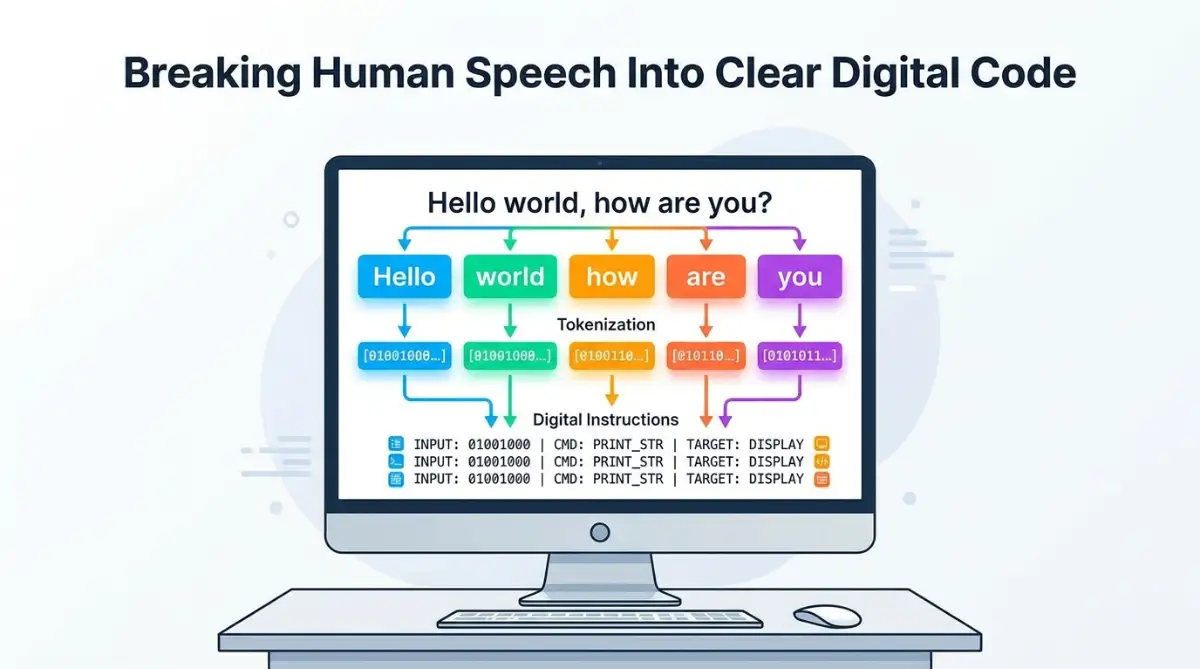
To build a helper that feels human, we must first teach computers how to read. Human speech is messy, full of slang, and changes based on our feelings. Smart software uses a set of clean, logical steps to turn your text into numbers it can calculate.

The very first step in this process is called tokenization. When you type a sentence, the system does not read the whole line at once. Instead, it breaks your sentence down into individual words or small phrases called tokens.
For example, if you type "I need help," the system divides this into "I," "need," and "help." This makes it much easier for the computer to analyze each piece step by step. It is very similar to how children use their fingers to point at single words when learning to read.
Humans use many extra words to make their sentences sound smooth and polite. Words like "the," "is," "at," and "on" are very common in human language. However, these words do not carry the core meaning of your request.
The system performs a step called stop word removal to clear out these extra words. By removing these words, the software can focus solely on the action words and nouns. This saves processing power and allows the system to find your answer much faster.
People use different forms of the same word depending on when and how they speak. You might type "running," "runs," or "ran" when talking about physical movement. To a simple computer, these look like three completely different concepts.
Through a method called lemmatization, the system reduces these variations to their base form, which is "run." This allows the computer to group similar meanings together without getting confused by grammar rules. It ensures that the bot knows exactly what action you are discussing.
Once the system has clean words, it needs to know how those words relate to each other. It assigns a label to each word, such as noun, verb, adjective, or pronoun. This step is known as part-of-speech tagging.
Knowing whether a word is an action or a noun changes the entire meaning of a sentence. For instance, the word "book" can mean reading a novel or reserving a flight. By analyzing the grammar structure, the software makes the right choice.
Quick Q&A: Outsmarting the System
- Question: How do I bypass a stuck chatbot to get a real human?
- Answer: Type "Speak to agent" or "Human" three times in a row. Many customer service systems have a hidden rule that automatically transfers your chat after repeated failure triggers.
Insert the following bold text and your video embed right below the line above:
If you are a visual learner, watch this quick video below to see exactly how these smart bots actually read our words. After watching, keep reading to discover the hidden mistakes you might be making right now!
Advanced Ways Chatbots Learn to Think Like Humans
Modern AI assistants do not just look at single words; they try to understand the entire context of your message. This requires advanced methods that mimic how our own brains process conversations. Let us explore how these systems turn basic text into deep comprehension.
Smart systems use a method called sentiment analysis to detect how you feel during a chat. They look for specific emotional cues, like words of praise or terms of frustration. This helps the assistant decide if it should reply with a cheerful tone or pass the chat to a human agent.
For example, if you type "This is terrible," the bot instantly flags your message as highly negative. It will adjust its response to be more apologetic and helpful. This emotional tracking is key to making digital tools feel truly supportive.
One of the biggest issues with early chat systems was their short memory. They would forget what you said just one second ago. Modern systems use state tracking to remember your details throughout the entire conversation.
If you say "I want to book a room," and then say "Make it for two adults," the bot remembers the room. It connects the second sentence to the first one without asking you to repeat yourself. This creates a smooth flow that feels like a natural human discussion.
The final step is intent classification, where the system guesses what you want to achieve. It compares your typed sentence against thousands of pre-set goals in its database. Once it finds a match, it triggers the correct action to solve your query.
Many businesses now use these smart systems to help their clients complete complex tasks. For example, you might use a business helper when looking for top free AI tools that save hours of work to organize your daily schedule.

Five Hidden Mistakes People Make When Using and Designing Chatbots
Even the smartest systems can fail if we do not build or use them with care. Many creators and users fall into common traps that ruin the entire conversational experience. Knowing these pitfalls will help you get much better results from your daily technology.
Here is a quick pro tip from my own painful mistakes: always type your requests as if you are talking to a smart ten-year-old. I used to write long, complicated messages, but I quickly realized that breaking my problems into short, simple sentences gets me the exact answer I need.
- Expecting Perfection Instantly: Many users expect AI tools to know everything right away. You must remember that these tools learn slowly through continuous user interactions.
- Using Complex Slang and Idioms: Writing with local slang can confuse the system's processing filters. It is always best to keep your sentences simple and clear.
- Ignoring the Need for Human Backup: Some businesses replace their entire human support team with automated systems. This leaves customers stranded when complex issues arise.
- Forgetting to Update the Database: An AI tool is only as good as the information you feed it. Outdated databases will lead to false and misleading answers.
- Ignoring Simple Privacy Rules: Sharing highly sensitive personal data in public chat windows can be risky. Always check the safety policies before sharing personal information.
If you avoid these common errors, you will save yourself a lot of frustration. Businesses will see happier customers, and users will get the exact answers they need in seconds.
Your Path to Smarter and More Human Conversations
Understanding how natural speech processing works changes the way we look at modern communication tools. We no longer have to view these tools as mysterious black boxes that work by magic. Instead, we can see them as helpful helpers that simply need clear input to guide us.
As these tools grow more advanced, they will become even more integrated into our daily routines. They will help us manage our time, organize our finances, and answer our burning questions instantly.
From my own experience, taking just a few seconds to write clear text completely changes how these bots treat you. I want you to try this simple trick today the next time you talk to an AI, and you will be amazed at how much time and energy you save.
We encourage you to start practicing clear and simple communication when using these tools today. Try breaking your long questions into short, direct points and watch how much better the answers become. By doing so, you will unlock the true power of conversational technology and make your digital life much easier.