
Why Managing Money Used to Keep Me Awake at Night (And How I Fixed It)
Let me ask you an honest question: how many times have you panicked this month wondering if a random subscription just overdrew your bank account? If you are nodding your head right now, you are definitely not alone. I spent years constantly checking my banking app, doing stressed-out mental math just trying to buy a cup of coffee. The truth is, managing your money manually is a completely broken system. Today, I am going to show you exactly how to step away from the calculator and build a background system that does all the heavy lifting for you.
If you are constantly stressing about money, I completely understand your pain. Most everyday people wake up worrying about how they will juggle their upcoming bills. They manually log into multiple bank accounts every single day, trying to figure out if they have enough cash just to buy groceries.
This constant mental math is absolutely exhausting. It slowly drains your energy and completely destroys your peace of mind. When you manage your money manually, human error always manages to get in the way of your goals.
You might forget a specific due date and get hit with a nasty late fee. Or worse, you might accidentally spend the cash that was supposed to cover your upcoming electricity bill. This creates a terrible cycle of guilt, anxiety, and frustration.
When every single financial decision requires extreme effort, you naturally experience severe decision fatigue. You eventually end up giving up on your wealth-building goals just to get through the stressful day.
Your Quick Action Plan for Today:
- Set up one single 'hub' checking account where all your paychecks land.
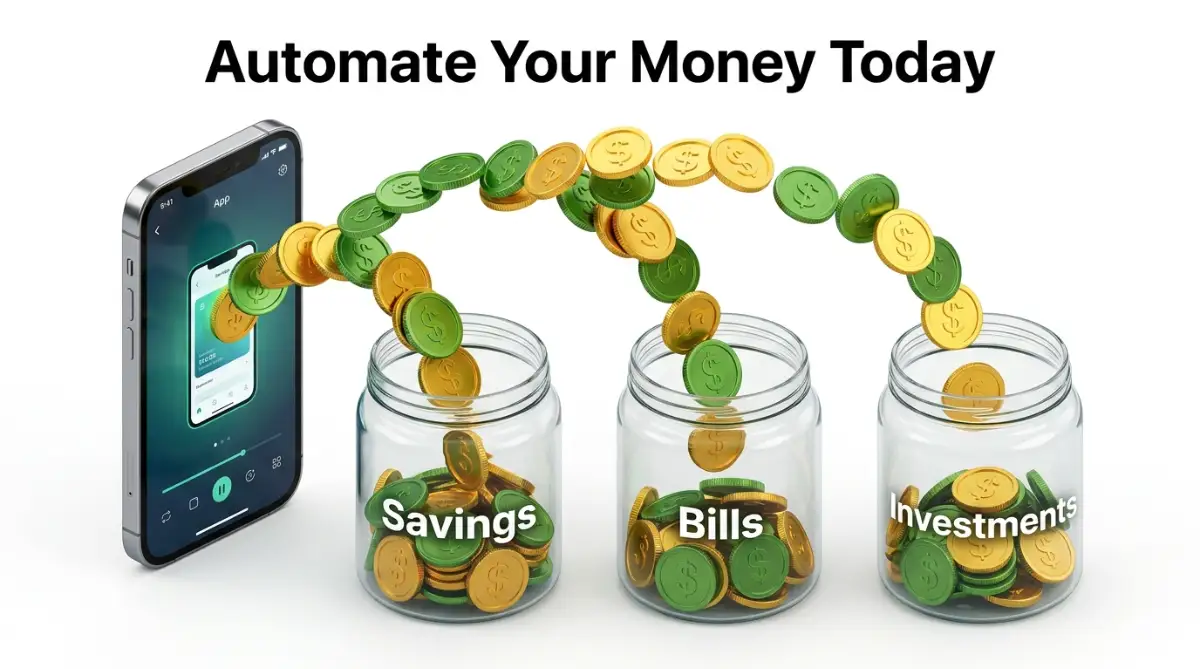
- Create a rule to automatically move your savings exactly one day after payday.
- Call your main service providers to align all your bill due dates with your pay schedule.
- Build a permanent cash buffer to stop annoying overdraft fees forever.
Building Your Invisible Money Machine
Creating a system that handles your money automatically is the greatest gift you can give your future self. Once you set this up, you will never have to rely on your memory to pay a bill again. You will learn exactly how to build a reliable, hands-off system that grows your wealth quietly in the background.
Establishing Your Main Financial Hub
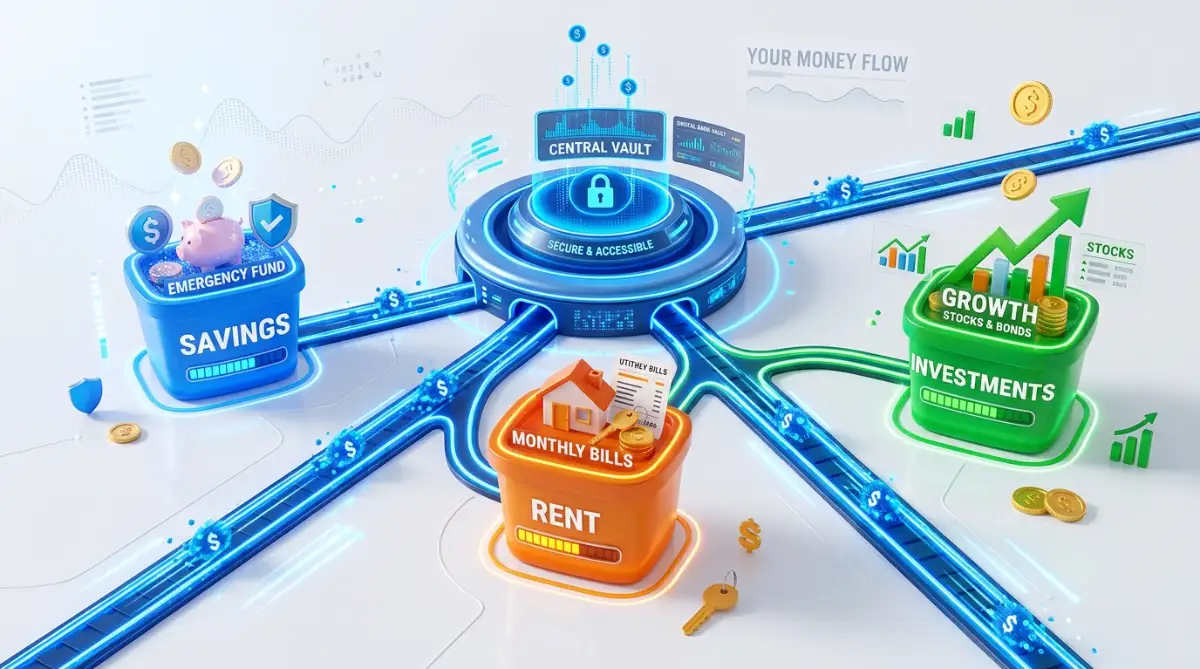
The very first step is to pick one primary checking account to act as your central money hub. Think of this account as a busy train station where all your money arrives and departs. Every single penny you earn from your job or business must enter this specific account first.
Having multiple checking accounts for your income will only confuse you and break the system. You need absolute clarity on exactly how much money is coming in every month. Find a reliable bank that offers a checking account with zero monthly maintenance fees.
Once you have your central hub, you need to set up direct deposit with your employer. This ensures your paycheck lands in your account automatically without you having to visit a bank branch. The faster the money hits your hub, the faster your system can put it to work.
The Psychology Behind Paying Yourself First
Most people follow a completely backwards approach to saving money. They pay their rent, buy their groceries, go out for dinner, and then try to save whatever cash happens to be left over. The painful reality is that there is rarely any money left over by the end of the month.
Your lifestyle will naturally expand to consume all the money you leave in your checking account. This is a recognized psychological pattern called Parkinson's Law. To beat this law, you must move your savings out of your checking account the very second you get paid.
I used to wait until the end of the month to save whatever cash was left over. My realization was painful: there is never any money left over! Now, I treat my savings transfer as my most important monthly bill, and it happens automatically before I even wake up on payday.
Creating the Automatic Savings Transfer
Log into your online banking dashboard and locate the automatic transfer settings. You need to create a recurring transfer from your checking account to your savings account. Schedule this transfer to happen one day after your paycheck normally arrives.
If you get paid on the 1st of the month, schedule the transfer for the 2nd. This one-day buffer protects you just in case your employer is slightly late with processing the payroll. Start with a small amount if you are nervous, even just fifty dollars a month makes a huge difference.
Automating Your Fixed Expenses (So You Never Miss a Payment)
Fixed expenses are the bills that stay the exact same price every single month. This includes your rent or mortgage, car payment, internet bill, and streaming subscriptions. Since these amounts do not change, they are incredibly easy to put on autopilot.
Contact your service providers and ask them to move all your billing due dates to the same week. Aligning your due dates with your payday is the ultimate secret to a stress-free financial life. If you get paid on the 15th, ask to have your bills due on the 17th or 18th.
A Quick Script for Customer Service: Calling utility companies can feel awkward, but here is exactly what I say to make it fast: "Hi there, my pay schedule recently changed, and I need to move my monthly billing due date to the 18th so I can guarantee my payments are always on time. Can we update that right now?" It usually takes less than five minutes and saves you months of endless headaches.
Watching someone actually set up these automated transfers can make the whole process much easier to understand. Take a few minutes to watch this brilliant breakdown of setting up a zero-effort bill payment system before moving on to the next step.
Once your dates are aligned, set up auto-pay directly through your utility and service providers. They will automatically pull the exact amount they need from your central checking account hub. You will never have to type in your debit card numbers or remember passwords to pay a bill again.
Handling Credit Cards the Smart Way
Credit cards can completely destroy your financial life if you manage them poorly. However, if you automate them correctly, they become a highly rewarding financial tool. The golden rule is to always pay your entire statement balance in full every single month.
Log into your credit card portal and turn on the auto-pay feature immediately. Select the option that says "Statement Balance" rather than the "Minimum Payment" option. Paying only the minimum amount will trap you in a terrible cycle of high-interest debt for years.
If you are afraid that an automatic full balance payment will empty your bank account, you need to track your spending closer. You should only use your credit card for normal expenses that you already have the cash for. Treat your credit card exactly like a debit card, and the automated payment will never be a scary surprise.
Protecting Your Peace of Mind With an Auto-Funded Safety Net
Life is incredibly unpredictable, and surprise expenses will eventually happen to everyone. Your car might break down on the highway, or your home might need an urgent repair. This is exactly why you need an emergency fund sitting in a completely separate high-yield savings account.
Do not keep your emergency fund in the same bank as your main checking account. If you see that money every time you log in to pay a bill, you will be tempted to spend it. Open an account at a separate online bank that offers a high interest rate on your deposits.
Set up an automatic recurring transfer from your main hub to this new emergency account. Send a fixed amount over every single payday until you have three months of living expenses saved up. Once that bucket is full, you can pause the automatic transfer and redirect that money toward investing.
Myth vs. Reality of Setting Things on Autopilot
Many people are afraid to let computers handle their hard-earned money. Let us clear up some common misunderstandings about setting your finances on cruise control.
Digitizing the Classic Envelope Budgeting System
You might have heard of the old-school envelope system where people put physical cash into paper envelopes. This worked great in the past, but carrying physical cash is no longer practical or safe. Luckily, you can easily replicate this highly effective system using digital banking tools.
Many modern banks now allow you to create digital sub-accounts or "vaults" within your main account. You can create a digital envelope for groceries, one for dining out, and one for vacation funds. Instead of using paper money, you set up automatic rules to split your paycheck into these different digital buckets.
When it is time to buy groceries, you check your digital grocery envelope to see exactly what you can spend. This keeps your money organized and prevents you from accidentally spending your vacation fund on a random weekend dinner. It requires zero math once the initial digital routing rules are created.
Taming Irregular and Annual Bills
Not every bill arrives nicely packaged on a monthly schedule. Things like property taxes, car registration, and annual software subscriptions only show up once or twice a year. Because they happen so rarely, they usually catch people completely by surprise and ruin their monthly budget.
The best way to handle these sneaky expenses is to break them down into bite-sized monthly chunks. If your car insurance costs six hundred dollars for the entire year, you need to save fifty dollars a month. Create a specific digital savings bucket labeled "Annual Bills".
Set up an automatic transfer to send fifty dollars into that specific bucket every single month. When the large yearly bill finally arrives in your mailbox, you will not panic at all. The money will simply be sitting there waiting for you, and you can pay it instantly.
Investing on Autopilot Without Losing Sleep
Building real wealth requires you to invest your money in assets that grow over long periods. However, trying to time the stock market manually is a stressful game that most regular people lose. The smartest investors use a highly effective strategy called Dollar Cost Averaging.
This simply means buying investments on a strict, regular schedule, regardless of what the market is doing. You open an account with a reliable brokerage firm and link it to your central checking hub. Set up an automatic transfer to buy a broad market index fund the day after you get paid.
When the stock market is high, your automatic transfer buys fewer shares. When the stock market crashes, your same automatic transfer buys a lot more shares on sale. You never have to read financial news or stress about graphs because your system is doing all the heavy lifting.
Defeating Lifestyle Creep With Auto-Escalation
As you progress in your career, you will hopefully receive raises, bonuses, and better job offers. When people make more money, they usually just start buying more expensive clothes and eating at fancier restaurants. This dangerous habit is called lifestyle creep, and it keeps high-earners completely broke.
You can actually automate your defense against lifestyle creep using a strategy called auto-escalation. Many retirement and investment accounts offer a feature that automatically increases your savings rate by one percent every year. You will barely notice a one percent difference in your daily spending, but it creates massive wealth over decades.
Whenever you get a significant pay raise, immediately log into your banking app before you get used to the new income. Increase your automatic savings and investment transfers by half of your new raise amount. You still get to enjoy more spending money, but your wealth-building system gets a massive automatic boost too.
Why You Should Still Do a Monthly 15-Minute Check-In
Building an invisible money machine does not mean you can ignore your finances forever. You still need to make sure the gears are turning properly and no errors have occurred. I recommend scheduling a simple 15-minute financial date with yourself once a month.
Pick a quiet Sunday morning, grab your favorite cup of coffee, and quickly review your central hub. You just want to verify that your paycheck arrived and that all your automatic bills were paid on time. You should also scan your credit card transactions to make sure there are no fraudulent charges.
If everything looks good, you can close your laptop and go enjoy the rest of your month. This short review replaces the hours of stressful number-crunching you used to do. You get to maintain total confidence in your financial situation while putting in almost zero daily effort.
Supercharging Your Invisible Money Machine
Once you have your basic bills and savings running on autopilot, you will instantly feel a massive weight lift off your shoulders. However, if you truly want to build serious wealth, you can take this entire system one step further. Advanced financial automation is not about doing more work yourself. It is actually about setting up smarter rules so your money works exponentially harder for you while you sleep.
The Magic of Rule-Based Cash Sweeping
Most standard bank accounts simply hold your money and do absolutely nothing else. But modern banking apps now offer incredibly powerful features known as automated rule-based transfers. Instead of transferring a fixed dollar amount every month, you can tell your bank to monitor your account balance based on specific conditions.
You probably have a specific dollar amount in your head that makes you feel completely safe and secure. Let us imagine that your personal comfort number is three thousand dollars. You can easily set up a smart rule that checks your account balance every single Friday afternoon.
If your checking account balance ever crosses above that three thousand dollar mark, the bank acts immediately. It automatically grabs that extra cash and sweeps it directly into a high-yield savings account or an investment portfolio. You never have to manually decide to save that extra money, and you never leave lazy cash sitting around losing its value.
If you are currently struggling with monthly payments, your first priority should always be building a cash buffer while fighting debt before setting up these aggressive sweep rules. Once your basic safety net is firmly in place, this sweeping technique becomes a massive wealth multiplier.
The Real Math Behind Lazy Money: Let us look at the actual numbers. If you leave an extra $3,000 sitting in a standard checking account, it earns you about $0.30 a year. But if you set an automated rule to sweep that same $3,000 into a high-yield savings account (yielding around 4.5%), it earns you roughly $135 a year for doing absolutely nothing. That is literal free money you are ignoring by not setting up a simple rule.
Harnessing the Silent Power of Dividend Reinvestment
When you start buying stocks or index funds, those investments will regularly pay you small amounts of cash called dividends. It is essentially a free bonus simply for owning the asset. Most beginners make the massive mistake of letting that dividend cash sit uselessly in their brokerage account.
To truly automate your wealth creation, you need to turn on a feature called a Dividend Reinvestment Plan, commonly known as a DRIP. Every major brokerage platform offers this feature completely free of charge. Whenever a company pays you a cash dividend, the platform instantly uses that exact cash to buy more shares of that exact same company.
This creates a beautiful, unstoppable snowball effect over long periods of time. The new shares you just bought will then produce their own dividends, which will automatically buy even more shares. According to basic guidance on compound interest from Investor.gov, this continuous reinvestment cycle is one of the absolute most powerful mathematical forces for growing a massive retirement portfolio.
Automating Your Income as a Freelancer
The traditional financial advice always assumes you receive a perfectly predictable paycheck every two weeks. If you run a small business or work as a freelancer, your income probably jumps wildly from month to month. A fixed-dollar automatic transfer will completely crash your system during a slow month.
Instead of automating fixed amounts, you need to automate your money using strict percentages. Many modern financial technology apps allow you to route your incoming deposits based on custom percentage splits. For example, you can set a rule that automatically sends twenty percent of every single client payment directly to a separate tax savings account.
You can then direct another ten percent to your emergency fund and send the rest to your primary checking hub. This is incredibly helpful if you are currently launching your business without failing and need to maintain a highly stable cash flow. The system perfectly scales up during your highly profitable months and naturally scales down when business is temporarily slow.
Putting Your Generosity on Autopilot
Building personal wealth is incredibly rewarding, but sharing that wealth brings a completely different level of joy. Many people truly want to donate to their favorite charities, but they simply forget to do it during their busy daily lives. You can easily fix this by making your generosity a core part of your invisible money machine.
Take a moment to pick one or two organizations that genuinely mean a lot to your heart. Visit their official websites and look for their recurring monthly donation options. Set up a small, automatic monthly contribution using your credit card, and align the charge date closely with your payday.
Giving money away automatically keeps your brain firmly planted in an abundance mindset. It constantly reminds you that you have more than enough money to survive and thrive. Plus, having a clear record of automated monthly donations makes your annual tax preparation significantly easier.

The Dangerous Traps That Break Your Automated System
Putting your financial life on autopilot is generally an incredibly safe strategy, but it is not completely bulletproof. If you build your machine incorrectly, it can actually cause serious financial damage before you even realize what is happening. You must carefully avoid these specific, highly destructive traps that catch thousands of well-meaning people completely off guard.
The Illusion of "Set It and Forget It"
The absolute biggest mistake people make is treating their automated finances like a time capsule they can bury and ignore. They set up their direct deposits, link their bills, and then completely delete their banking apps. Automation is wonderfully comparable to driving a modern self-driving car on the highway.
The car can easily handle the steering and the braking, but you still need to keep your hands relatively close to the wheel. If your primary credit card suddenly expires and a new one is issued, every single automated payment attached to the old card will instantly fail. You will suddenly get hit with a wave of nasty late fees and threatening emails from your utility providers.
This is exactly why that short, monthly financial check-in we discussed earlier is absolutely non-negotiable. You only need a few minutes to quickly scan your dashboard and verify that all the green lights are shining brightly. If you completely ignore your system for months at a time, a tiny technical glitch can easily destroy your credit score.
Falling Victim to the Zombie Subscription Attack
When you do not manually review your bank statements, you become incredibly vulnerable to subscription creep. This happens when you sign up for a free trial of a streaming service or a fitness app and completely forget to cancel it. Because your bills are paid automatically, that sneaky company will quietly drain twenty dollars from your account every single month.
We lovingly call these "zombie subscriptions" because they refuse to die and they slowly eat your hard-earned cash. Over a long period, these tiny invisible charges can add up to hundreds or even thousands of lost dollars. You might be paying for a digital magazine you have not opened in months or a premium software tool you stopped using long ago.

To protect your system, you should conduct a ruthless subscription audit at least twice a year. Print out your most recent credit card statement and take a bright red pen to circle every single recurring charge. If a service does not bring you genuine joy or save you significant time, cancel it immediately and redirect that money directly into your investment bucket.
Automating While Running on Fumes
If your primary checking account constantly hovers right around zero dollars, aggressive automation will become your worst enemy. Imagine you schedule a massive two hundred dollar transfer to your savings account on a Tuesday. However, your employer accidentally processes your weekly paycheck one day late due to a banking holiday.
Your automated system does not care about holidays; it blindly executes the transfer exactly as instructed. Because the new money has not arrived yet, this transfer instantly pushes your checking account balance below zero. You will immediately get slapped with a painful thirty-five dollar overdraft fee from your bank.
That single unfair fee will completely wipe out a massive chunk of the interest you earned all year. To completely avoid this stressful trap, you must always maintain a permanent cash buffer inside your main checking hub. Keep an extra few hundred dollars in that account that you simply pretend does not exist.
Having this permanent buffer ensures that small timing mismatches never trigger a disastrous overdraft penalty. For excellent consumer protection tips on managing automatic payments safely, you can always review the official guidelines provided by the Consumer Financial Protection Bureau (CFPB).
Refusing to Hit the Emergency Pause Button
Your automated wealth machine is designed to perform perfectly during your normal, everyday life. However, life will eventually throw a massive, completely unexpected curveball directly at your head. You might unexpectedly lose your primary job, face a massive medical emergency, or need to take unpaid time off to care for a sick relative.
During a severe crisis, continuing to automatically aggressively invest your money is a terrible mathematical mistake. Your machine simply does not know that you just lost your main source of income. It will continue draining your precious remaining cash to buy index funds while you are desperately struggling to buy basic groceries.
If a true financial emergency strikes, you must swallow your pride and immediately hit the pause button on your investments. Stop all outgoing transfers to your brokerage accounts and aggressively hoard every single dollar in your cash reserves. Once the dangerous storm completely passes and your income stabilizes, you can simply flip the switches back on.
Ignoring Future Major Life Events
Many people build a beautiful automated system when they are completely single and living in a cheap apartment. However, they completely forget to update their financial rules when their life circumstances drastically change. When you get married, have your first child, or decide to buy a house, your old automated rules will no longer work.
Later on, when you are seriously preparing for your first property purchase, you will need a completely different savings strategy. You will need to aggressively divert funds away from your long-term retirement accounts and push them into a highly liquid down payment bucket.
When you eventually lock in a property, understanding your mortgage amortization schedule will require adjusting your monthly auto-pay amounts to match your new loan obligations. Always remember that your financial system is a living, breathing tool that must evolve exactly as your personal life evolves. You might even find yourself in a highly secure position where securing a bank loan without collateral becomes an incredibly simple process because your automated cash flow history is so pristine.
Stepping Into Your New Stress-Free Reality
When you successfully remove the heavy burden of manual money management, your entire perspective on life completely shifts. You suddenly stop viewing your bank account as a terrifying source of endless anxiety and panic. Instead, you begin to see your money as a highly cooperative, completely silent employee that works tirelessly for your family's future.
You will finally experience the incredible joy of waking up on payday and doing absolutely nothing. By the time you pour your morning coffee, your bills are already paid, your savings are securely tucked away, and your investments are growing. This beautiful invisible system protects you from your own worst spending habits and perfectly guarantees your long-term success.
Building wealth is rarely about being the smartest person in the room or picking the absolute perfect winning stock. It is almost entirely about extreme consistency, deep patience, and completely removing human error from the equation. The initial setup might take you a few hours this weekend, but it will easily save you thousands of hours of intense worry over your lifetime.
My personal promise to you: I used to wake up in a cold, terrified sweat wondering if my debit card would decline at the local grocery store. Today, my automated system works quietly in the background while I sleep, giving me total freedom to focus on the things I genuinely love. I want you to take just one hour this evening to set up your very first automatic transfer, because you absolutely deserve to experience that exact same peace of mind.
Real Questions Normal People Ask About Money Automation
Is it completely safe to link all my bank accounts together online?
Yes, modern banking systems use incredibly powerful encryption to protect your sensitive data during every single transfer. As long as you use highly reputable banks and always enable two-factor authentication on your apps, your money is extremely secure. You actually reduce your risk of fraud because you are not constantly typing your debit card numbers into random websites.
What if my income changes wildly every single month?
If you are a freelancer or a highly commissioned salesperson, you cannot rely on fixed-dollar transfers at all. You need to use percentage-based routing rules that adjust naturally based on exactly how much you earn. During a massive month, your system saves a lot more, and during a slow month, it comfortably scales back to protect your cash flow.
How much of my actual paycheck should I automatically save?
A very popular starting point is the classic fifty-thirty-twenty budgeting rule, which suggests saving roughly twenty percent of your total income. However, if that specific number feels way too aggressive right now, just start with a tiny five percent transfer. The most important thing is simply building the automated habit today, and you can easily increase the amount later as your confidence grows.
Should I fully automate my massive credit card payments?
You should absolutely automate your credit card payments, but only if you choose the specific option to pay the full statement balance. Setting up an auto-pay for just the tiny minimum payment will permanently trap you in a highly destructive cycle of debt. If paying the full balance scares you, you need to drastically cut back your daily credit card spending until it matches your actual available cash.
What happens if an automatic bill accidentally causes an overdraft?
If you completely forget to maintain a small cash cushion in your main checking account, an automated bill might push your balance below zero. Your bank will quickly charge you an annoying overdraft fee, which is incredibly frustrating to deal with. To prevent this permanently, always keep a hidden buffer of roughly two to three hundred dollars in your main account that you pretend simply does not exist.
Disclaimer: The highly detailed information provided in this article is meant strictly for educational and informational purposes only and does not constitute professional financial, legal, or investment advice. Everyone's personal financial situation is completely unique. You should always consult with a certified financial planner or a licensed professional advisor before making any major decisions regarding your hard-earned money, investments, or debt management strategies.