The Secret Confusion Draining Your Tech Confidence
I remember sitting in a team meeting a few years ago, secretly sweating while my coworkers threw around terms like "neural networks" and "machine learning." I nodded my head to blend in, but honestly, my mind was completely blank, and I felt so embarrassed. That was the exact moment I promised myself I would figure this out and break down these scary tech words into simple ideas anyone can understand.
Have you ever sat in a business meeting or scrolled through social media and felt completely lost when people started talking about AI? You hear someone mention a predictive model, and then another person talks about deep neural networks.
You nod along, trying to look smart, but deep down, you feel like you are falling behind. This constant flood of technical words can make you feel stressed and overwhelmed.
It is easy to feel like you need a math degree just to understand how modern software works. You want to learn, but every article you open is filled with complex equations and heavy jargon.
This struggle is very common, and it is not your fault. The tech world loves to make things sound more complicated than they actually are.
Let us change that today. We are going to break down these concepts into simple, everyday ideas that anyone can grasp.
You do not need to write code to understand how these systems shape our daily lives. By the end of this guide, you will feel confident discussing these tools with anyone.
What Exactly Is a Machine Learning Model?
To understand this concept, let us start with a simple, real-life story. Imagine you want to teach a young child how to identify different types of fruit.
You do not write a long rulebook for the child to read. Instead, you show them ten apples and ten oranges.
You point to each one and say, "This is an red apple," or "This is an orange." After looking at them, the child learns the patterns, like color, shape, and skin texture.
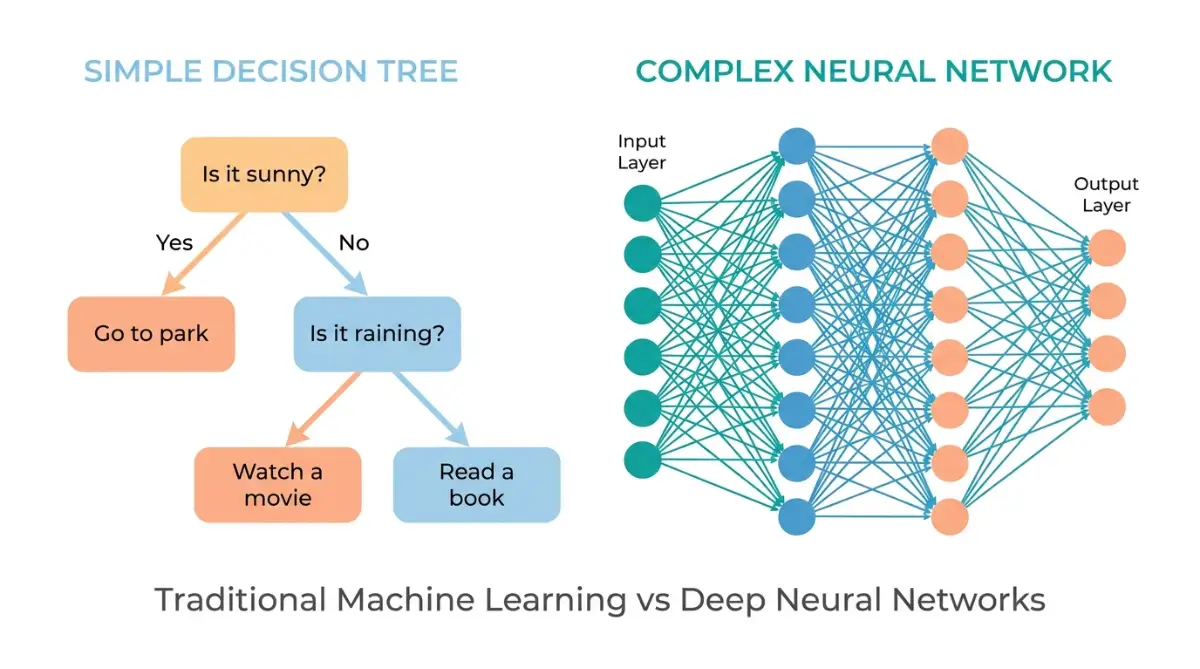
This is exactly how traditional machine learning works. Machine learning models are systems that learn from structured data without being manually programmed with strict rules.
Instead of writing code that says "if it is red and round, it is an apple," we feed the system labeled data. The system finds the mathematical patterns on its own.
However, there is a catch with traditional machine learning models. A human engineer must point out the key features first.
For example, you have to tell the system to look at the color and the weight of the fruit. This step is called feature extraction.
If you do not help the system identify these key features, the model will struggle to make accurate predictions. It is smart, but it still needs a human to guide its focus.
How Deep Learning Algorithms Take It to the Next Level
Now, let us imagine a much bigger challenge. What if you want a system to look at millions of mixed photos and recognize every single object, from cars and dogs to human emotions?
Doing this with traditional machine learning would take forever because humans would have to define every single feature. This is where deep learning algorithms come into play.
Deep learning is a specific subfield of machine learning. You can think of it as a highly advanced, automated version of machine learning.
Instead of needing a human to point out features, deep learning models do this entirely on their own. They use layers of artificial neural networks that mimic the structure of the human brain.
These networks pass the data through many different layers of calculations. The first layer might detect simple lines, the next layer looks at shapes, and the final layers identify complex objects.
For a deeper technical look at how neural networks calculate these layers, you can read the official documentation on Scikit-Learn to understand basic model structures.
This self-learning process is what makes deep learning incredibly powerful. It does not need a human to hold its hand during the learning stage.
If you feed it millions of cat photos, it will figure out what makes a cat look like a cat. It detects patterns that a human engineer might never even notice.
The Core Differences: Side-by-Side Comparison
To help you visualize these differences, let us look at a simple breakdown of how these two approaches compare.This comparison highlights that one is not always better than the other. They are simply built for different kinds of tasks.
If you are feeling confused about whether a balance transfer card or a personal bank loan is better for you, watch this short video to see exactly how both options work. Once you finish watching, keep reading below to discover the sneaky spending traps you need to avoid!
Myth 1: Deep Learning is Always Better Than Machine Learning
Many people think that deep learning is always the superior choice. This is simply not true.
If you have a small dataset, a deep learning algorithm will perform poorly and likely fail. Traditional models are much faster, cheaper, and more accurate for smaller, structured datasets.
Myth 2: Neural Networks Actually Work Exactly Like the Human Brain
While neural networks are inspired by the brain, they are not actual brains. They are complex mathematical equations that calculate probabilities.
They do not think, feel, or possess common sense. They simply find patterns in numbers very quickly.
Myth 3: You Need a PhD to Use These Tools
You do not need an advanced degree to start using machine learning. Today, simple software tools allow anyone with basic computer skills to build and run functional models.
Understanding the difference is about logic, not advanced mathematic
Smart Secrets to Choosing the Best Tool for Your Project
Now that you know how these systems work, you might wonder how experts decide which one to use. Making the wrong choice can waste time and money.
Let us look at the main factors that guide these professional decisions.
The Rule of Data Size
Your decision always begins with the data you have. Traditional machine learning models are highly efficient when you have limited data.
If you only have a few hundred rows of spreadsheet data, standard models are your best bet. Trying to use deep learning here is like using a rocket ship to go to the grocery store.
Deep learning algorithms are hungry for data. They only start to show their real power when you feed them millions of data points.
If you want to read more about how massive neural systems process deep patterns, check out the technical resources on IBM Deep Learning Topics for an in-depth breakdown.
The Power of Your Hardware
Another major factor is the computer hardware you have access to. Machine learning models are lightweight and friendly.
You can easily train a regression model on a standard office laptop in a couple of minutes. This makes it highly accessible for small businesses and individuals.
Deep learning requires massive computing power. You need specialized graphics cards, often costing thousands of dollars, or expensive cloud computing services.
Without this hardware, training a deep neural network would take months of continuous processing.
The "Black Box" Challenge
Think about how important it is to explain your decisions. If a bank uses an algorithm to deny a loan, they must explain why they made that choice.
Traditional machine learning models are highly transparent. You can open the model and see exactly which factor, like income or debt, caused the system to deny the application.
This level of transparency is incredibly important in fields like finance and lending. For example, when platforms evaluate financial profiles, they rely on clear data points.
If you are currently studying how financial systems look at debt and risk management, understanding these clear models is key. You can see this logic in action when you read about student loan consolidation and avoiding risks to see how clean data leads to better financial paths.
Deep learning models, on the other hand, are often called "black boxes." Because the data passes through hundreds of hidden mathematical layers, it is nearly impossible to explain exactly why the model made a specific prediction.
This makes it difficult to use in areas where safety and legal regulations require clear explanations.
You might not realize it, but these algorithms are working behind the scenes every time you interact with your bank or check your credit. Let us look at how these tools are used to protect your personal information.
When you apply for a credit card or a loan, the bank does not just guess your risk level. They run your financial history through highly optimized machine learning models.
These models look at your repayment patterns, your current bills, and your overall credit history to make a fast decision.
This is highly similar to the manual steps you take when audit processes are used to find errors in your files. For example, you can use structured systems to improve your own score.
If you want to take control of your financial profile, learning how to clean up your record is highly beneficial. You can follow a step-by-step guide to cleaning up mistakes on your credit report to make sure your data is accurate before any algorithms scan it.
Furthermore, these predictive models are used to calculate the risk of personal loans. If a buyer has a lower score, the model might suggest adding a partner to the application.
This mathematical safety net is why lenders highly value shared responsibility. If you want to understand how this helps you secure better rates, check out why having a co-signer is your best move for a low-interest personal loan to lower your risk profile.

The Worst Mistakes People Make with AI Software
When beginners jump into building tech solutions, they often fall into dangerous traps. Here are the biggest pitfalls you need to avoid.
Overcomplicating Simple Tasks
The most common mistake is using a massive neural network for a simple problem. Many developers waste weeks setting up deep learning systems to predict simple sales trends.
A basic linear regression model could have solved the problem in five minutes. Here is a practical pro tip from my own experience: early in my career, I actually wasted three whole weeks trying to build a complicated deep learning system for a basic sales spreadsheet. I quickly realized that throwing heavy tech at a simple problem just creates a giant mess, so now I always force myself to test the easiest option first.Always start with the simplest model possible and only build up if necessary.
Ignoring the Quality of Your Data
Many people believe that a smart algorithm can fix bad data. This is a massive mistake.
In the tech industry, there is a famous saying: "Garbage in, garbage out." If your input data is messy, incomplete, or biased, even the most advanced deep learning system in the world will give you bad results.
You must spend time cleaning, organizing, and verifying your data before you ever show it to a model.
Forgetting About Long-Term Maintenance
Building a model is only half the battle. Over time, real-world patterns change, and your model will start to make mistakes. This is known as model drift.
If you do not set up a plan to regularly monitor and update your system with fresh data, your tool will eventually become useless.
Your Action Plan for Mastering Tech Logic
Let us wrap things up with a simple checklist to help you apply this knowledge in your daily life.
- Step 1: Identify the Data Type — Look at your project. Is your data in structured spreadsheets, or is it unstructured, like raw videos and audio?
- Step 2: Choose Your Starting Point — If your data is structured, start with traditional machine learning models to save time and computing power.
- Step 3: Check Your Resources — Ensure you have the right hardware before you even attempt to run a deep learning algorithm.
- Step 4: Keep Learning — Keep exploring how these tools shape different industries, from healthcare to financial management.
If you are using data-driven strategies to improve your own life, you can also use structured plans to tackle real-world challenges. For instance, if you are currently dealing with academic costs, you can apply smart tracking methods to break free from education debt with a complete forgiveness strategy to achieve real financial freedom.
The world of artificial intelligence does not have to be scary or confusing. Now that you understand the basic logic behind these systems, you can confidently participate in the digital age.
Start looking at the software you use every day and try to guess whether it is running on a simple machine learning model or a deep learning algorithm. You might be surprised by how much you can now understand.
From my own journey, I can promise you that mastering these simple basics will completely change how you see the digital world around you. Do not let big tech words scare you away—take what you learned today, look at your favorite apps, and start noticing the amazing math happening right behind your screen!
Disclaimer & Content Notice
This blog post is for educational and informational purposes only. The concepts discussed represent general industry practices and software architectures. Always consult with certified tech professionals and financial advisors before implementing complex software systems or making major financial commitments.