The Heavy Burden of Academic Reading: Why We Get Lost in the Pages
I remember sitting at my desk last year, crying over a massive stack of research papers for my final project. My eyes burned, and I felt completely stupid because I spent three hours just trying to understand one single page. I honestly thought I was not smart enough for college, not realizing that the old way of reading was actually breaking me down.
Imagine sitting at your desk at two in the morning with a hot cup of tea. Your eyes are dry, and your head is spinning from looking at a fifty-page research paper. You need to find one small detail for your paper, but it is buried deep inside a wall of complex text.
It feels like you are drowning in a sea of scientific words and confusing charts. This is the daily reality for so many of us who want to learn and grow. We want to understand the latest science, but the sheer volume of words keeps us trapped in a cycle of endless reading.
- Many of us try to skim the pages quickly, but we often end up missing the most important points.
- Some people rely on quick online summaries that are often filled with wrong facts and bad information.
- Others copy and paste huge blocks of text into basic translation tools, which completely ruins the original context.
- We often read only the abstract, which means we miss how the study was actually done.
- Many students download useless tools that promise fast results but only give broken, confusing sentences.
- This endless cycle of struggle makes us feel extremely anxious about our academic skills.
- We start to doubt our own intelligence when we cannot make sense of a long, dry paragraph.
- The constant pressure to keep up with new research slowly ruins our free time and peace of mind.
- We feel like we are always falling behind our friends, which slowly damages our confidence.
We live in a world where thousands of new papers are published every single day. Our human brains, however, still work the same way they did hundreds of years ago. We only have a limited amount of energy and mental focus to use each day.
When you spend hours trying to decode a single document, you have nothing left for writing. It is not your fault that you are finding this so hard. Academic writers often use ten words when they could easily use three.
This creates a huge barrier between you and the valuable knowledge you need to succeed. You deserve a simpler, faster way to learn without losing your happiness. Let us look at how modern tools can help us clear this heavy fog.
The Smart Way to Read: How to Tame Long Documents with AI
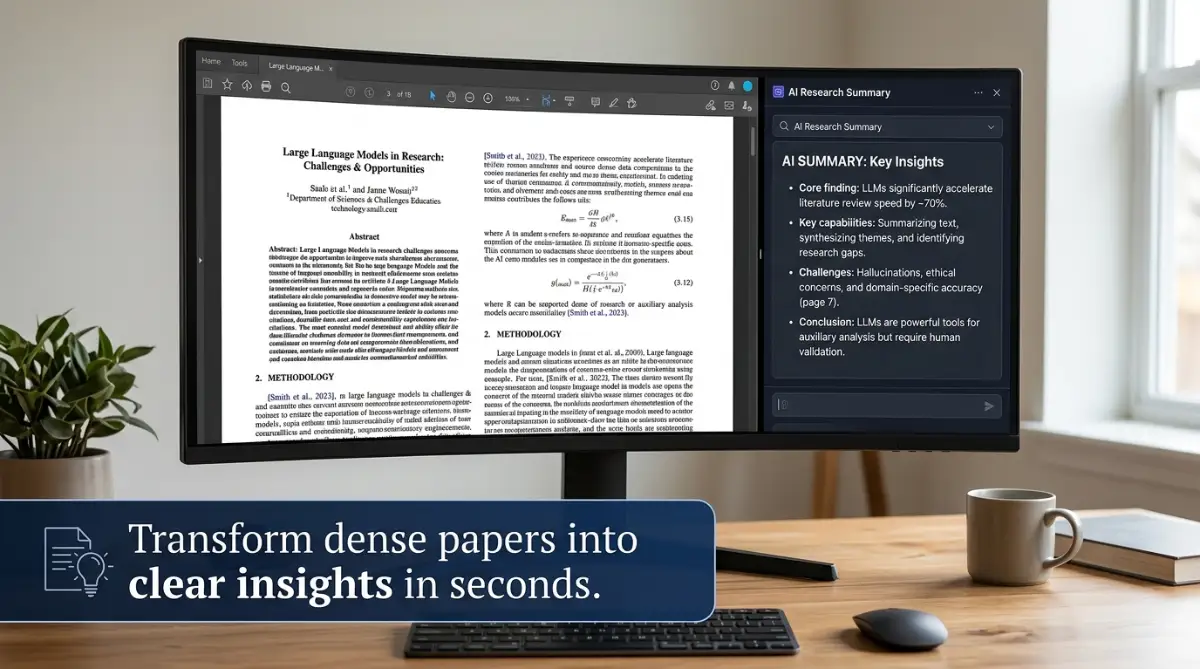
Now you know that reading long documents the old way is holding you back. It is time to learn a much smarter approach using modern tools. Let us explore the first three steps to help you master this process today.
If you are a visual learner who wants to see exactly how I summarize a heavy 50-page document in just two minutes, watch my quick video guide below before you jump into the next steps!
Step 1: Getting Your PDF Ready for the AI
Before you upload any file to an AI tool, you need to prepare it. Many people make the mistake of uploading messy, scanned files and expecting a perfect summary. If your file is a scanned document, the AI might read the letters incorrectly.
Make sure you use a clean, digital version of your document. If your document is a scan, run it through a free online OCR tool first. This simple step makes sure the AI can read every single word with high accuracy.
Think of this step like washing your vegetables before you start cooking. A clean input always leads to a high-quality meal. You can use free web tools to convert and clean your files in just a few seconds.
It is also a great idea to remove pages you do not need, like the cover or the long reference list. This keeps the AI focused entirely on the main content of the paper. Most free PDF editors will let you split and save only the pages you want to read.
Step 2: Picking the Best AI Tool for Your Reading Goals
All AI tools are not created equal. Some tools are made for short news stories, while others are built for heavy science papers. You must choose a tool that fits your specific learning needs.
Look for a tool that offers a chat feature instead of just a simple summary. This lets you ask specific questions about the paper, turning reading into a fun conversation. It makes the whole learning process much more active and exciting.
Imagine you are reading a complex study about sleep habits. You do not just want a generic summary of the whole document. You want to ask, "How many hours of sleep did the active group get?"
A good chat-focused AI can find that specific data point in a split second. Try out a few free tools before you buy any premium plans. Look for tools that protect your data and keep your documents private.
Step 3: Writing the Perfect Instructions for Your AI Assistant
The secret to getting an amazing summary lies in how you ask for it. If you just type "summarize this," you will get a very boring and generic response. You need to give your AI helper a clear role and specific rules.
Tell the AI exactly who you are and what you want to learn. For example, you can tell it: "Act as a friendly teacher and explain this paper to a beginner." This simple prompt changes the entire tone of the output.
You can also ask the AI to format the summary in a specific structure. Ask for a brief introduction, three bullet points of the methods, and a list of key findings. This structured look makes the summary incredibly easy to scan on your phone.
Here is a simple template you can copy and use right now:
"Please summarize the attached research paper. Highlight the main goal, the methods used, and the three main lessons in simple bullet points." Try using this prompt today and watch how much better the results are.
My biggest mistake when I first used these tools was just typing "read this" and hoping for the best. I quickly realized that if I talk to the AI like a real study partner and give it specific rules, the answers I get are ten times better. Trust me, spending an extra minute to write a clear prompt will save you hours of fixing bad summaries later.
Why AI Summaries Save Your Brain Power
Using these tools is not about being lazy. It is about managing your mental energy so you can focus on what truly matters. When you do not have to spend hours decoding text, you have more energy to think deeply.
Think of an AI summarizer as a helpful assistant who reads the paper first. They highlight the most important parts and explain them to you in plain English. This lets you decide if the paper is worth reading in full.
This method is very similar to looking at a map before you start a long road trip. It shows you the best routes and the main stops along the way. You still do the driving, but you are much less likely to get lost.
Avoiding Common Mistakes When Using AI Tools
While AI is highly useful, we must remember that it is not perfect. Sometimes, AI can make mistakes or misinterpret complex data. This is why we must always use these tools with a bit of caution.
Always double-check the most important numbers and facts in the original paper. You can do this quickly by searching for the key terms inside the PDF. Treat the AI summary as a helpful guide, but keep the original paper open for safety.
Think of the summary as a quick movie trailer. It gives you the main plot and the exciting scenes, but you still need to watch the key parts of the movie. This simple habit keeps your research highly accurate and professional.
How This Simple Process Changes Your Daily Life
When you master this workflow, your study habits will change completely. You will no longer feel stressed when your teacher or boss hands you a massive stack of papers. You will know exactly how to handle them in a fraction of the time.
You will have more time to spend with your family, exercise, or just relax. Your grades and your work quality will improve because you can cover more ground. You will become a faster, smarter learner who is always ahead of the game.
This new confidence will show in your writing and your discussions. You will be able to speak clearly about complex topics because you understand them deeply. It is a simple shift that brings massive positive changes to your academic life.
A Real-Life Example of Smart Reading
Let us look at a quick story to see how this works in real life. Meet Sarah, a college student who had to read fifteen research papers for her final project. She was feeling extremely stressed and ready to give up.
Instead of trying to read every page word for word, she used an AI document summarizer. She cleaned her files, used our custom prompt, and got clean summaries for each paper. She finished her research in just two hours instead of twenty.
Sarah got an excellent grade on her project and slept well every night. Her story shows that with the right tools, anyone can achieve great results. You can start doing the same thing today and save your valuable time.
Keeping Your AI Summaries Organized for Later Use
Once you start creating these summaries, you need a smart way to store them. Do not let them sit in your downloads folder where they will be forgotten. Set up a simple digital notebook for your summaries.
You can group them by topic, project name, or date. Always include a link to the original paper so you can find it easily if needed. This simple habit turns your reading sessions into a highly valuable personal library.
Over time, you will build a rich database of easy-to-read knowledge. You will never have to spend hours looking for that one old research paper again. Everything you need will be right at your fingertips, organized and ready.
Taking Your Research to the Next Level: Pro Tips for Smart Summaries
Now that we have covered the basics, let us look at some advanced methods to make your reading even faster. Many top universities suggest that active reading is the best way to remember hard facts. If you want to see how top scientists approach reading, you can check out the official Nature journal archives for high-quality studies.
When you use tools to analyze documents, you are not just saving time. You are also training your brain to spot key ideas much faster. Many academic experts at Google Scholar agree that organizing your search keywords before reading is highly useful.
We can combine these scientific methods with our digital assistants to build a highly powerful workflow. For instance, you can use specialized academic databases to find the most trusted files. If you want to see how top schools train their students, look at the research guidelines on the University of Oxford website.
These methods help you avoid getting lost in thousands of pages of dry text. If you want to speed up your general daily tasks beyond reading, you can check out some of the top free AI tools that save hours of work in your study sessions.
By combining smart search habits with automated summaries, you will stay ahead of your workload. You will be able to process ten papers in the time it used to take to read just one. Let us jump into the advanced steps you can start using today.
Step 4: Connecting the Dots Across Multiple Documents
Most people only summarize one paper at a time. However, the real magic happens when you ask your tool to compare two or three different papers. This is called cross-document analysis, and it is a game-changer for researchers.
You can upload three different studies on the same topic into your workspace. Then, ask your tool to find the main points where the authors agree or disagree. This method gives you a complete overview of a topic without any extra effort.
For example, imagine you are a researcher studying modern banking systems. You might need to summarize complex papers on how students can obtain loans without pledges. Summarizing three different financial reports at once will help you find the best options in minutes.
This approach is like having a meeting with three different experts in the same room. You get to hear all their opinions at once, which saves you hours of writing notes. Try this method next time you have a major project due.
Step 5: Building Custom Templates for Your Study Library
To keep your results consistent, you should create your own set of prompt templates. Once you find a prompt that works perfectly, save it in a text file. This saves you from having to invent a new prompt every single time.
You can have one template for medical papers, one for history essays, and another for business reports. Each template should ask for different types of data depending on the topic. This keeps your study library highly organized and neat.
For instance, think of a student who needs to research personal finance options. Before they learn how to borrow with confidence, they must read pages of complex bank terms. Having a custom template helps them extract terms, fees, and rules instantly.
They can use the same template to find the best ways to borrow money without collateral instead of feeling lost in legal jargon. This simple trick turns a scary task into a fast and easy process.
A Guide to Keeping Your Fast Reading Habits Consistent
Starting a new habit is easy, but keeping it going for months is the real challenge. To get the best results over time, you need to make this process a natural part of your week. Set aside a specific hour every week just for summarizing your reading list.
Do not wait until the night before an exam to start using your digital assistants. Use them daily to summarize short articles, news updates, and class notes. This regular practice keeps your skills sharp and ready.
Over time, you will develop a natural feel for how your favorite tools respond to your prompts. You will know exactly when to trust a summary and when to open the original paper. This balance is what makes you a true modern researcher.
Remember that your digital tools are here to support your unique human brain. They should never completely replace your own critical thinking and problem-solving skills. Use the summaries as a starting point to spark your own brilliant ideas.
Think of it like using a bicycle to travel faster instead of walking. The bicycle helps you cover more distance, but you are still the one doing the steering. Keep your mind active, ask hard questions, and let technology handle the heavy lifting.

Hidden Traps: What to Avoid When Summarizing with AI
While these digital tools are amazing, they can also lead to mistakes if we are not careful. Let us look at the five biggest mistakes people make and how you can avoid them.
Mistake 1: Trusting the Summary Without Any Verification
One of the biggest mistakes you can make is assuming the AI is always correct. AI models can sometimes make up facts or get numbers wrong. If you use these incorrect facts in your paper, your grades or work will suffer.
Always cross-check important data, names, and statistics with the original document. It only takes a minute to search the PDF for the key number. This simple step protects your academic reputation from silly mistakes.
Mistake 2: Using the Same Generic Prompts Every Time
Many users type "summarize this PDF" for every single document they upload. This lazy habit gives you flat, unhelpful summaries that might miss what you actually need. Different papers require different levels of detail.
Take a moment to change your prompts based on the subject of the paper. Ask for specific details, like the sample size or the research methods. This keeps your summaries highly useful and tailored to your goals.
Mistake 3: Uploading Messy or Poorly Formatted Files
If you upload a dark, blurry scan of a paper, the AI will struggle to read the text. It might skip whole paragraphs or misread key words. This leads to a broken summary that is completely useless to you.
Always make sure your documents are clean and easy for the computer to read. If a document looks bad, convert it or find a better copy online. Spending a minute to clean your file saves you hours of frustration later.
Mistake 4: Trying to Read Too Many Summaries at Once
It is easy to get excited and summarize fifty papers in one afternoon. However, your brain cannot process that much information all at once. You will end up feeling just as overwhelmed as before.
Take a slow and steady approach to your digital reading lists. Focus on three to five papers at a time, and take breaks between them. This keeps your mind fresh and helps you actually remember what you read.
Mistake 5: Neglecting the Original Author's Main Voice
While summaries are great, they often lose the author's unique tone and emotion. If you only read summaries, you might miss the subtle arguments and style of the writer. This can make your own writing feel dry and robotic over time.
Make sure you read the full introduction and discussion sections of the best papers. This helps you understand the author's voice and deepens your appreciation of their work. Balance is the key to becoming a brilliant writer.
Your Path to Smarter and Faster Learning
Learning how to use these modern tools is a game-changer for your academic journey. You now have the keys to unlock thousands of pages of research in just a fraction of the time. The old days of feeling overwhelmed by long files are finally over.
Start small by uploading just one paper today and using our simple prompts. You will be amazed at how quickly you can turn a hard paper into clean, helpful bullet points. This small step is the beginning of a much more relaxed and successful study life.
Looking back at my own journey, learning how to use these smart reading tools gave me my life and free time back. You do not have to suffer through endless dry texts anymore, so please give this simple method a try right now. I promise that once you see how easy it is to breeze through heavy papers, you will never want to read the hard way again.
Believe in your ability to learn faster and master any subject you choose. With your smart digital assistant by your side, there is no limit to what you can achieve. Take action today, save your valuable time, and enjoy your new learning adventure.