How I Almost Lost My Artistic Soul to the Machine
I remember the exact moment I realized something was terribly wrong with my daily routine.
For months, I had been plugging my ideas into smart software, letting the machine do the heavy lifting for me.
At first, it felt like pure magic, saving me countless hours of brainstorming, drafting, and editing.
But one rainy morning, I stared at a completely finished piece on my monitor and felt absolutely nothing inside.
The work was technically perfect, yet it completely lacked my personal touch, my quirky humor, and my actual soul.
That is when the harsh reality hit me hard: I had not just outsourced my daily tasks, I had accidentally outsourced my passion.
This is a silent struggle happening to thousands of people right now. We are trading our inner joy for extreme efficiency, and it is quietly destroying our mental peace.
When you stop doing the actual work, you also stop experiencing the natural high that comes from solving a difficult problem. The human brain needs that sweet release of dopamine we get from overcoming a tough challenge.
By letting a machine take over every single step, everyday people are waking up feeling completely useless. They sit at their desks, click a button, and watch the screen do the magic.
At the end of the day, there is no sense of pride left in the work. You just feel like a robot managing another robot.
This deep sense of emptiness spills over into our personal lives, making us easily annoyed, mentally exhausted, and entirely disconnected from the things we once loved. It is a modern tragedy hiding behind the promise of easy productivity.
Reclaiming the Human Element: A Balanced Approach to AI
If you are feeling that familiar sense of emptiness, do not panic. You can absolutely take back control of your artistic process without throwing away your smart tools.
We just need to rethink how we use them. The goal is to make these tools act like helpful assistants, rather than total replacements for your brain.
Let us look at some highly practical, science-backed steps you can start applying today to protect your unique voice.
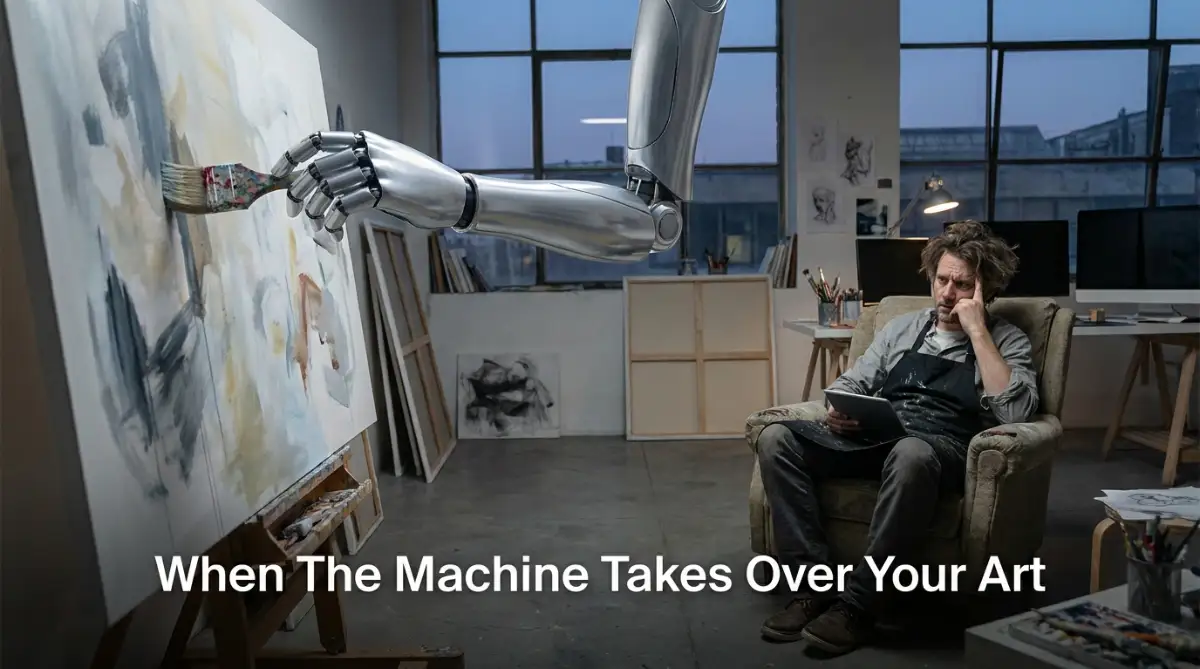
The Psychology Behind True Satisfaction
To fix this problem, we first need to understand how our brains naturally work. Scientists often talk about something called the "IKEA effect."
This is a psychological rule showing that humans place a much higher value on things they build themselves. When you assemble a chair with your own hands, you love it more, even if it is slightly crooked.
The exact same logic applies to your daily projects. If software generates a perfect article, image, or design for you in three seconds, your brain does not value it.
You miss out on the healthy struggle that makes the final result feel rewarding. Without that struggle, your self-esteem slowly begins to drop over time.
Myth vs. Reality in Modern Creation
- The Myth: Maximum efficiency always leads to higher happiness and better output.
- The Reality: Extreme efficiency often kills the joy of the process, leaving the creator feeling empty and burnt out.
Recognizing the Red Flags of Over-Reliance
How do you know if you have gone too far with digital assistance? The signs are usually very quiet at first.
You might notice that your recent projects all look incredibly similar to each other. The colors are perfect, the words are grammatically flawless, but everything feels totally flat.
Another major red flag is your reaction to feedback. When someone criticizes your automated work, you probably do not care at all.
Since you did not pour your heart into making it, you feel completely disconnected from the final product. You might even secretly agree with the negative comments.
If you are experiencing these feelings, it is a clear warning sign. Your brain is begging you to get your hands dirty again.
The Real Cost of Pushing the 'Generate' Button Too Often
Every time we bypass the messy middle of a project, we lose a chance to grow. The messy middle is where the best ideas actually hide.
It is during those moments of extreme frustration that our brains make strange, beautiful connections. When you let an algorithm skip that part for you, you get a highly predictable outcome.
Predictable is boring, and the modern audience hates boring. People crave authentic, slightly flawed, and raw human experiences.
Watch This Breakdown Before You Automate Another Task:
Before you set up another endless loop of automated tasks, you need to understand the hidden psychological traps waiting for you. This insightful breakdown shows exactly what happens to a creator's mind when they step away from the driver's seat.
Setting Boundaries with Your Digital Assistants
Just like you would set boundaries with a pushy coworker, you must set strict rules for your software. You cannot let the machine make the final decisions.
Decide early on which parts of your process are entirely off-limits to digital help. Maybe you always write your own outlines, or perhaps you insist on mixing your own colors by hand.
Whatever it is, guard that specific step with your life. This gives your brain an anchor, reminding you that you are still the master of the project.
I used to let smart software generate all my initial ideas, thinking it would break my writer's block. I soon realized my work started sounding exactly like everyone else's, which forced me to delete everything and start over from scratch with a simple pen and paper.
That small shift back to analog brainstorming completely saved my career. It reminded me that the machine is only there to speed up the boring parts, not to do the dreaming for me.
A Practical Framework to Keep Your Unique Voice
So, how do we find the perfect balance? I like to use a simple rule: automate the frame, but hand-paint the picture.
You can use technology to handle data sorting, basic formatting, or checking for simple errors. These tasks do not require your emotional energy.
However, anything that requires empathy, humor, or a personal opinion must come directly from your own brain.
Here is a quick look at how you should divide your daily tasks:
Why Flaws Make Your Work Highly Valuable
We live in an era where everything generated by computers is completely flawless. The grammar is perfect, the pixels are exact, and the tone is perfectly polite.
Because perfect is now so easy to create, it has lost all its special value. Think about the last time you saw a perfectly smooth, heavily edited photograph on social media.
Your eyes probably glazed right over it. But when you see a slightly blurry photo that captures a raw, highly emotional moment, you stop and look.
The same applies to your writing, your designs, and your business strategies. Your personal quirks and tiny mistakes act like a fingerprint.
They tell the audience that a real, breathing person is on the other side of the screen. By refusing to fully automate your work, you are actively protecting the most valuable thing you own.
You are protecting your humanity.
Rebuilding Your Creative Stamina
If you have been relying on tools heavily for a long time, doing the hard work yourself might feel exhausting at first. Your creative muscles have simply gone soft.
Think of it like going back to the gym after a long vacation. The first few days are going to hurt, and you might want to quit.
Start very small. Try completing just one tiny project entirely from scratch this week. Do not use any smart helpers, no matter how tempting it gets.
Sit with the frustration. Stare at the blank page. Let your mind wander and struggle to find the right words or colors.
When you finally finish that small project, pay close attention to how you feel. I guarantee you will feel a deep, warm sense of accomplishment that no software could ever give you.
This feeling is the cure to the silent burnout. It is the exact reason why we started making things in the first place.
Moving Beyond the Basics: Mastering the Hybrid Workflow
Now that we understand why pushing a single button is ruining our artistic drive, we have to talk about what comes next. You cannot just abandon all modern technology and go back to drawing in a dark cave.
If you completely ignore these smart assistants, your competitors will eventually outpace you. The secret is not running away from technology, but learning how to dance with it on your own terms.
We need to build a hybrid routine where you remain the undisputed boss of the project. Let me share a few advanced strategies that have completely transformed how I handle my daily tasks.
The "Draft Zero" Technique for Protecting Originality
One of the smartest moves you can make is changing when you actually open your software. Most people open their browser, stare at a blank screen, and instantly ask the machine for an idea.
This is the exact moment you lose your unique voice. Instead, I want you to try something called the "Draft Zero" technique.
Before you touch any digital helper, sit down with a physical notebook and spend ten minutes writing out your raw thoughts. It does not matter if the spelling is terrible or the ideas seem messy.
This messy brain dump becomes your anchor. Once you have this authentic human core, you can then feed it into the software to help organize the mess.
By starting analog, you force the machine to adapt to your personality, rather than the other way around.
Training the Algorithm Instead of It Training You
A huge mistake I see creators making is accepting the first output a program gives them. They type in a prompt, get a generic result, and just shrug their shoulders.
If you want to maintain your creative soul, you have to treat the software like a highly capable, but slightly stubborn, intern. You have to push back and demand better.
When I am generating stunning realistic visuals with software, I never accept the default style. I constantly tweak the instructions, telling the program to make it warmer, grittier, or more emotional.
You need to understand how these machine learning models actually process data so you can outsmart their default settings. They are programmed to give you the most average, statistically safe answer possible.
Your job is to push the machine out of its safe zone and force it to match your specific vision.
Protecting Your Cognitive Energy for the Final Polish
Think of your daily energy like a battery on your smartphone. Every time you make a decision, that battery drains just a little bit.
If you spend all your energy on boring things like formatting tables or checking spelling, you will have nothing left for the fun stuff. This is where automation becomes your best friend.
According to recent studies on psychological effects of excessive screen automation, freeing your brain from repetitive administrative tasks actually reduces long-term burnout. You want to hand over the boring chores to the machine.
Let the software clean up your audio, format your code, or organize your messy spreadsheets. Save your precious mental battery for the final polish.
That final 10% of a project is where the absolute magic happens. It is where you add a funny joke, a surprising plot twist, or a specific shade of color that only you could dream up.
The Hidden Traps That Quietly Destroy Digital Creators
While trying to balance this new workflow, I have stumbled into some pretty dark holes along the way. When you first realize how much time automation saves, it becomes incredibly addictive.
You start looking for ways to automate absolutely everything in your life. This obsession with extreme efficiency often leads straight into a brick wall.
Let us look at some of the most dangerous traps people fall into when they let the machine take the wheel completely.
The "Echo Chamber" Effect in Digital Art
Have you ever noticed that a lot of internet content is starting to look and sound exactly the same? This is the echo chamber effect in full swing.
When millions of people use the exact same software to write articles or design logos, a global sameness takes over. The system trains on existing data and spits out slight variations of the exact same thing.
If you rely entirely on this system, your brand simply blends into the background noise. Your audience will quietly scroll right past your work because it feels strangely familiar and completely boring.
I once noticed my own blog posts were starting to sound like a textbook, completely stripped of my usual sarcastic humor. That was my wake-up call to stop letting the algorithm rewrite my jokes.
Giving Up Your Ownership and Legal Rights
This is a massive trap that almost nobody talks about until it is too late. When you let a program generate your entire final product, you might not actually own it.
Right now, there are strict federal guidelines on AI copyright ownership that say you cannot copyright something created entirely by a machine. If a large company decides to steal the design you generated, you might not have any power to stop them.
You need to be extremely careful if you are securing legal protection for your digital assets.
To legally protect your work, you must prove that a significant amount of human effort went into creating it. Your personal edits, your structural changes, and your unique additions are what make the work legally yours.
The Silent Erosion of Your Brand Trust
Your audience is much smarter than you think. Even if they cannot clearly explain it, humans have a natural instinct for spotting fake things.
When you publish something entirely automated, your readers or clients will pick up on the weird, robotic tone. It might be a phrase that sounds a bit too polite, or an image where the lighting just feels off.
The moment they realize a machine did all the talking, their trust in you instantly drops. Building a loyal audience takes years, but losing their respect only takes one obviously fake post.
If you are successfully launching a new creative agency, maintaining trust is your absolute biggest priority. People pay premium prices for human connection, not for automated generic files.
Ignoring the Hidden Security Vulnerabilities
Sometimes the dangers are not just about art; they are about safety. We get so comfortable with these tools that we forget they are connected to massive, public databases.
Many creators blindly upload sensitive client information, private financial data, or unfinished company secrets into these programs to help summarize them. This is a massive mistake.
If you are relying heavily on automated coding scripts or sending private data into a public chat box, you are exposing yourself to severe risks. Anything you type into these free tools can often be used to train the next version of the software.
You always need to read the fine print before treating a digital assistant like a private diary.
Taking Back the Reins of Your Daily Routine
We have covered a lot of ground today, from the psychology of why we feel empty to the legal risks of giving up control. The main thing I want you to remember is that you are still the artist.
These incredible new programs are simply digital paintbrushes. A paintbrush cannot dream up a beautiful portrait, and it certainly cannot feel the joy of finishing one.
You have to intentionally protect the messy, difficult, and beautiful parts of your daily work.
Start treating your smart tools like entry-level assistants. Let them handle the boring research, the heavy data lifting, and the basic structural outlines.
But when it comes time to add the emotion, the perspective, and the final polish, you must sit in the driver's seat.
A Quick Action Plan for Tomorrow Morning
Tomorrow, when you sit down at your desk, try making one small change to your routine.
Pick one project and refuse to use any smart assistance for the first thirty minutes. Just you, your thoughts, and a blank canvas or notebook.
Embrace that initial feeling of struggle. Remind yourself that this exact struggle is what makes your final product incredibly valuable to the rest of the world.
If you are regularly testing out everyday digital applications, make it a habit to judge them on how much human effort they preserve, not just how much time they save.
I know how tempting it is to let the machine do everything when you are tired. But protecting your unique, slightly flawed human voice is the smartest investment you will ever make in your career.
I promise you, doing the hard parts yourself will always feel infinitely better than watching a loading bar do it for you. Your art deserves your actual presence, and so does your peace of mind.
Burning Questions Creators Ask About AI Dependency
Will smart software eventually replace human creators entirely?
No, it will simply change the way we work. Audiences will always crave the unique emotional connection and personal storytelling that only a real human being can provide.
How can I tell if I am relying too much on automation?
If you feel completely emotionally disconnected from your final projects, you have probably gone too far. Another big sign is if you stop caring about receiving feedback because the work does not feel like yours anyway.
Is it legally safe to sell completely machine-generated artwork?
This is a very tricky gray area right now. Currently, works created entirely by machines cannot hold copyright protection, meaning anyone else can legally use your generated files without asking.
Can using digital assistants make my brain lazy?
Yes, constantly skipping the problem-solving phase can slowly reduce your mental stamina. Just like a muscle, your imagination needs a healthy amount of struggle and friction to stay sharp and active.
What is the best way to start finding a healthier balance today?
Start by doing your initial brainstorming on real paper before touching your keyboard. Force yourself to outline your own core ideas before asking any software to help you expand on them.
Disclaimer: The information provided in this article is for educational and informational purposes only. It does not constitute legal, financial, or professional advice. The digital landscape and copyright laws regarding automated tools change frequently. Always consult with a certified legal professional regarding copyright claims, and ensure you comply with the terms of service of any software or platform you use.