The Trap of the Automated Mind: How I Lost My Edge
I remember staring blankly at a simple email reply I needed to send to my project team. Instead of thinking about what to say, my fingers instantly opened a new AI chat tab out of pure habit. I just typed "write a quick update email," copied the result, and hit send without even checking it properly. It felt like a harmless little shortcut at the time. But a few weeks down the line, I realized I could barely string two sentences together without asking a machine to fix my tone.
My own unique voice was slowly fading away, replaced by perfectly structured but entirely lifeless words. I found myself doubting my own decisions. If I had to plan a weekend trip or brainstorm a gift idea, my brain immediately outsourced the job. I was treating a chatbot like an absolute authority on everything.
You might be feeling this exact same friction in your own daily routine. People everywhere are secretly struggling with this silent mental fog. We think we are hacking our productivity and saving precious hours. But in reality, we are slowly turning off the most powerful problem-solving engine we have: our own minds.
This constant outsourcing creates a heavy feeling of self-doubt. When you let an algorithm do all the heavy lifting, your mental stamina drops to zero. You start feeling easily overwhelmed by basic tasks that you used to handle with your eyes closed. The peace of mind you thought you were gaining is actually replaced by a quiet anxiety. You start wondering if you are even capable of doing good work on your own anymore.
It steals our confidence and leaves us feeling like frauds in our own lives. We are forgetting how to sit quietly with a problem and just think. And this is exactly where the hidden danger lies.
The GPS Effect on Your Brain: Understanding the Danger
To understand what is happening to our minds, we have to look at how we process information. Have you ever used a mapping app so much that you forgot the way to your own friend's house?
Scientists call this "cognitive offloading." When we know a machine is holding the information for us, our brain simply stops trying to remember it.
The exact same thing happens with your reasoning skills when you over-rely on chatbots. When you immediately ask an AI to solve a complex problem, you are skipping the messy, uncomfortable part of learning. But that discomfort is exactly where growth happens.
Think of your brain like a muscle in the gym. If you go to the gym every single day but let a robot lift all the heavy weights for you, your muscles will shrink. Your brain works on a strict "use it or lose it" policy.
When you bypass the struggle of thinking, your neural pathways begin to weaken. You become a passive consumer of information rather than an active creator. Over time, this makes you highly vulnerable to accepting fake information just because it sounds professional.
The Illusion of Competence
One of the biggest traps we fall into is thinking we are getting smarter. Because we can generate a brilliant essay in five seconds, we trick ourselves into believing we actually hold that knowledge.
But there is a massive difference between generating an answer and understanding an answer. If someone asked you to explain that exact same topic in a coffee shop without your phone, could you do it?
Most people cannot. This creates a fake sense of intelligence that shatters the moment you are forced to think on your feet in the real world.
Reclaiming Your Mental Sharpness: A Practical Approach
You do not have to delete your apps or go entirely off the grid to fix this. The goal is to build a healthy boundary between your own intellect and the tool you are using.
You need to shift from being completely dependent to being intentionally collaborative. Here are some highly effective, science-backed ways to wake your brain back up.
The "Draft First, Ask Later" Rule
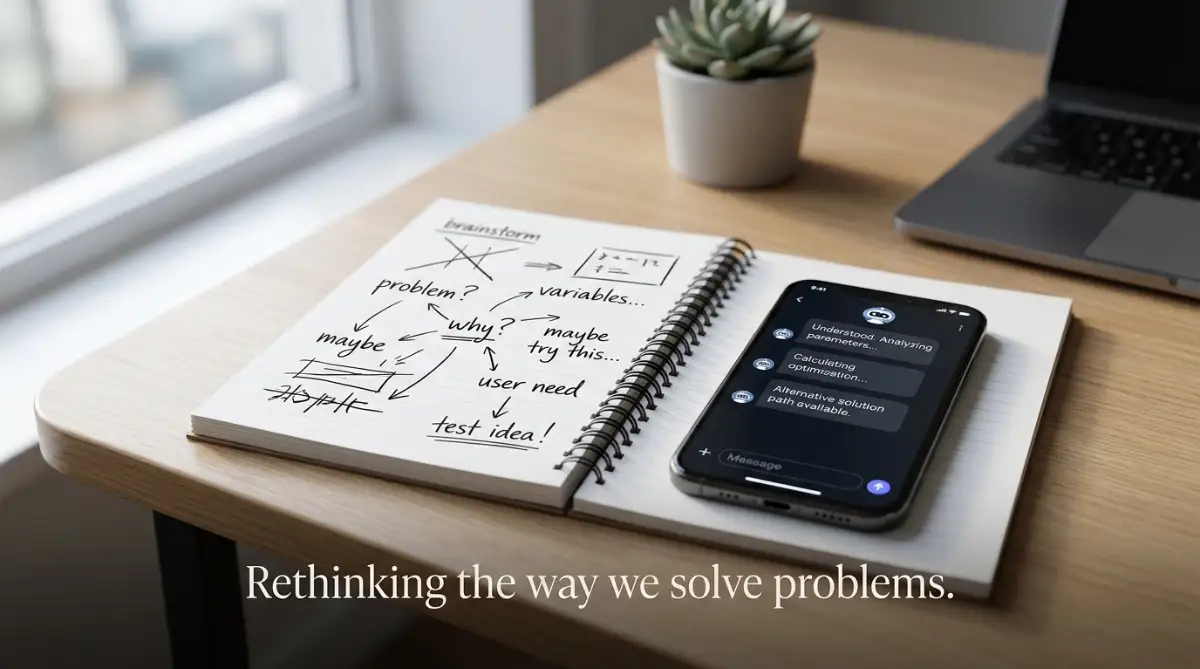
This is perhaps the most powerful habit you can start building today. Whenever you have a task, whether it is writing a report, coding a small script, or planning a meeting, force yourself to create the first draft completely alone.
Do not open any AI tools. Grab a pen and paper if you have to. Write down your raw thoughts, no matter how messy or unorganized they look.
Your brain needs this struggle. The act of pulling thoughts from your head onto a blank page fires up your creative centers. Once you have a basic outline or a rough draft, then you can use the AI to help you polish it or check for blind spots.
This keeps you in the driver’s seat. You remain the master of the core idea, and the tool merely acts as your assistant.
My personal turning point came when I started using this exact rule. I used to ask the machine for ideas first, which always boxed in my creativity.
I noticed that when I gave it an empty prompt, I got generic, boring answers. But when I fed it my own chaotic, original thoughts first, the final result was ten times better. It felt like I was actually collaborating instead of just copying. I realized that my raw ideas, even with mistakes, had a human warmth that a machine could never fake.
Embrace the Frustration of the Block
When we get stuck on a problem, our immediate reaction is to look for an escape. We hate the feeling of not knowing the answer right away.
But psychologists tell us that cognitive friction is highly beneficial. That frustrating moment when you are staring at a problem is your brain actively searching through its archives, trying to build new connections.
If you instantly hand the problem over to a machine, you short-circuit that beautiful process. Next time you hit a wall, set a timer for fifteen minutes.
During this time, you are not allowed to search for the answer online. You just have to sit with the problem. Draw diagrams, talk out loud, or walk around the room. You will be shocked at how often your brain can find the solution if you just give it a little breathing room.
Why You Need to Watch This Breakdown
Understanding how your brain reacts to instant gratification can completely change the way you work. Check out this incredible explanation on how modern technology rewires our focus and what you can do to stop it today.
Question Everything (Even the Perfect Answers)
Machines are designed to sound highly confident, even when they are completely wrong. They do not have doubts or hesitation.
If you passively accept everything they spit out, your analytical thinking will drop rapidly. You must train yourself to be a healthy skeptic.
When you receive a generated response, do not just copy and paste it. Read it carefully. Ask yourself, "Is this actually true?" or "Does this make logical sense in my specific situation?"
Take a moment to cross-reference the facts with a trusted search engine or a book. This simple habit of verification forces your brain to stay engaged. It keeps your critical evaluation skills sharp and prevents you from spreading accidental misinformation.
Daily Habits to Protect Your Cognitive Health
Protecting your mind requires building intentional friction back into your life. You have to make certain things harder on purpose.
Schedule Tech-Free Thinking Blocks
We are constantly consuming information. From the moment we wake up to the moment we sleep, data is pouring into our eyes and ears.
Your brain needs silence to process all of this. Block out twenty minutes every single day where you have zero screens around you.
Go for a walk without your phone. Sit on your balcony with a cup of tea. Let your mind wander freely. Daydreaming is an incredibly complex cognitive function that helps connect unrelated ideas.
If you are always plugging a machine into your brain, you never get the chance to daydream.
Read Full Books, Not Just Summaries
We have developed a terrible habit of asking bots to summarize long articles and books. While this saves time, it destroys our attention span.
When you read a full book, you are doing much more than just gathering facts. You are following an author's complex argument from beginning to end.
You are holding different characters, timelines, and ideas in your memory all at once. This builds immense mental endurance.
Reading a three-bullet-point summary gives you the data, but it denies you the mental workout. Pick up a physical book. Feel the pages. Force your eyes to track across the paragraphs and let your brain do the heavy lifting of imagination.
Engage in Real Human Debates
Machines are designed to please you. They will agree with your prompts, adjust to your opinions, and rarely challenge your worldview.
If you only talk to an algorithm, your ability to handle opposing viewpoints will disappear. You need to talk to real people who disagree with you.
Sit down with a friend and discuss a difficult topic. Listen to their arguments. Formulate your response in real-time without looking anything up.
Human conversation is messy, unpredictable, and highly emotional. Navigating that complexity is one of the best ways to keep your reasoning skills sharp and your empathy intact.
The Long-Term Reward of Independent Thinking
When you step back from total dependency, things will feel harder at first. Your work might take a little longer.
You might feel frustrated staring at a blank page. But very quickly, you will start noticing a profound shift in your confidence.
Earning Back Your Self-Trust
There is an unmatched feeling of pride that comes from solving a difficult problem entirely on your own. When you write an email that perfectly captures your emotion, or when you untangle a messy project with your own logic, you build self-respect.
You stop feeling like an imposter. You know that if the internet suddenly went down, you would still be highly capable and valuable.
Staying Irreplaceable in a Changing World
As technology continues to advance, generating basic content will become entirely worthless. Anyone can push a button and get a standard answer.
What will actually matter is unique human insight. The ability to connect strange dots, the courage to take a creative risk, and the empathy to understand real human emotion.
If you outsource all your thinking today, you will have nothing unique to offer tomorrow. But if you protect your mind and use these tools responsibly, you will stand out completely.
Your thoughts will have depth, your ideas will have soul, and your problem-solving skills will be razor-sharp. Do not let convenience rob you of your brilliance. Take back the wheel, embrace the struggle, and start thinking for yourself again.
Rewiring Your Brain for Deep Work and Focus
How do you keep your brain actively engaged when a helpful bot is always just one click away? You need to build a protective system around your mental energy. It is all about creating healthy boundaries that actually stick in your daily routine.
One incredibly effective method is setting a strict "tech delay" for your daily tasks. When you face a new problem at work, wait exactly one hour before asking a machine for help. This simple pause forces you to explore your own memory and logical reasoning first. You will be completely amazed at how many solutions are already hiding inside your own head.
During this delay, pick up a physical pen and write out your thoughts on paper. The physical act of writing slows down your racing mind in a very healthy way. According to researchers at the MIT McGovern Institute for Brain Research, taking the time to slowly process information helps your neurons form stronger, long-lasting connections.
You also need to understand the basic underlying mechanics of the platforms you use every day. If you take the time to learn how machine learning and deep learning actually work, your perspective will completely change. When you realize it is just a complex pattern-matching algorithm, you stop treating it like a flawless magic oracle.
The Feynman Technique for Digital Detox
Another massive secret to staying sharp is teaching the concept to someone else entirely from memory. If you use an automated tool to generate a weekly report, immediately explain the core findings to a coworker. If you cannot explain it naturally without reading the screen, you did not actually understand it.
This simple vocal test exposes the missing gaps in your knowledge right away. It forces your brain to convert passive reading into active comprehension. You have to synthesize the information and make it your own.
Let us talk about long-term maintenance for your cognitive health. You cannot just try a digital detox for three days and expect your brain fog to vanish forever. You need to turn these little moments of friction into permanent, everyday habits.
For instance, if you are working on a highly creative project like generating realistic images with AI, do not just accept the very first output. Spend serious time tweaking your own ideas, adjusting the creative words, and challenging the machine to match your unique vision. You must remain the strict director of your work, rather than just a passive observer.
Gamify Your Mental Workouts
You can also gamify your problem-solving process to make it highly engaging. Challenge yourself to complete one major task every single week using absolutely zero automated assistance. Treat this exercise like a heavy mental marathon.
The intense pride you feel after finishing a complex project all by yourself will give you a massive confidence boost. You will slowly remember exactly how capable you were before these apps even existed.
When people decide to pick a major for career success or learn a brand new programming language, they often let algorithms build their entire study plan. This is a massive mistake that completely robs you of the learning journey. Building your own messy study schedule helps you intimately understand your own personal weaknesses and strengths.
Experts at the American Psychological Association (APA) have consistently noted that self-directed learning builds a type of mental resilience that passive reading simply cannot match. You have to willingly endure the uncomfortable confusion of the learning curve. If you bypass that initial confusion, your educational foundation remains incredibly weak and fragile.
The moment a real-world problem breaks the standard pattern, you will completely freeze up in panic. Embracing the daily struggle is the absolute only way to build true, lasting expertise in any field.

The Hidden Traps We Fall Into When Using Smart Tools
Even when we try our best to be careful, it is incredibly easy to slip back into lazy habits. These tech platforms are specifically designed by engineers to be highly addictive. They offer instant gratification, which constantly tricks our brain's dopamine system into feeling highly productive.
One of the biggest mistakes people make is completely confusing raw speed with actual effectiveness. You might be able to answer fifty client emails in one hour using an automated responder. But if those specific emails lack your personal touch, you will slowly damage your professional relationships.
People can spot robotic, soulless language from a mile away. I once nearly ruined a major client pitch because I relied too heavily on a generated sales script. I sounded completely unnatural in the meeting and could not answer their simple off-script questions. It was a very painful lesson in why authentic human connection always wins the day.
The Danger of Blind Trust in Tech
Another massive trap is trusting these digital platforms for technical accuracy without verifying the raw facts. This behavior is especially dangerous in highly specialized or technical career fields.
For example, relying blindly on automated systems can easily expose your company to dangerous AI code generators and software security risks. If you do not intimately understand the code yourself, you will never be able to spot the hidden vulnerabilities. You are essentially leaving your front door wide open for disaster.
We also heavily tend to use these easy tools as a crutch for highly emotional or difficult conversations. Have you ever nervously asked an app to write a quick apology text to a hurt friend? Doing this completely removes all the genuine sincerity from the human interaction.
We are silently trading our deep human empathy just for the sake of temporary convenience. Over time, this specific habit quietly destroys our natural social skills and makes us emotionally numb.
The Illusion of True Competence
According to insightful research published by the Stanford Institute for Human-Centered Artificial Intelligence, heavy over-reliance on automated decision-making can lead to a severe erosion of human judgment. When you stop actively thinking for yourself, you slowly stop trusting your own gut instincts.
That tragic loss of self-trust bleeds into every single area of your daily life. You start second-guessing your own financial plans, your business strategies, and even your creative hobbies.
For example, when an aspiring entrepreneur is launching a business without failing, the real value comes from the intense planning phase. If a machine writes your entire business plan in ten seconds, you will lack the emotional grit needed to execute it. You miss out on the deep mental preparation that happens when you brainstorm late into the night.
People also completely forget to set personal boundaries when evaluating new digital trends. Whenever you sit down to review the latest gadgets and everyday apps, you must honestly ask yourself one single question. "Is this specific tool enhancing my current skills, or is it entirely replacing my ability to think?"
If it completely replaces your thinking process, you need to use it with extreme caution. Do not let a convenience tool become your master.
A Quick Audit Checklist for Your Brain Health
Instead of just worrying about the problem, let us look at a simple, actionable way to check your daily habits. Ask yourself these honest questions before you open your browser tomorrow morning:
- Do I feel highly anxious when I have to write a simple email without digital help?
- Have I recently accepted a technical answer without double-checking the main source?
- Am I losing my unique tone of voice in my personal writing and daily communication?
- Do I immediately look for an easy shortcut when a project gets slightly confusing?
If you answered yes to more than two of these questions, it is time to slowly pull back. You are heavily experiencing the initial stages of severe cognitive offloading. But do not panic, because the human brain is highly adaptable and can easily bounce back.
It just takes a little bit of intentional friction to wake your sleeping neurons back up. The next time you are trying to understand a complex mortgage amortization schedule explained without the confusing math, grab a cheap calculator and do the basic math yourself. The sheer satisfaction of understanding the numbers on your own is worth the extra five minutes of effort.
Your Roadmap to Reclaiming Independent Thought
We currently live in a fast-moving society where raw speed is often valued significantly more than actual substance. But true human brilliance takes serious time, quiet patience, and a whole lot of mental effort. You always have the distinct power to step right off this endless treadmill of automated thinking.
Start incredibly small today with just one minor adjustment to your routine. Pick just one single task that you normally outsource to a machine, and do it entirely by yourself. Embrace the highly messy, wildly imperfect process of raw human thought.
The heavy mental struggle you feel in that moment is just your brain waking up from a very long, deep sleep. It is highly similar to the muscle soreness you feel after returning to the gym. That slight pain is the exact feeling of your mental sharpness slowly coming back to life.
It is definitely not about rejecting modern technology completely and living in a cabin in the woods. It is all about putting these highly powerful tools back in their rightful, restricted place. They are strictly meant to be your helpful assistants, not your complete mental replacements.
When you fiercely protect your own cognitive health, you become an incredibly valuable person in any industry. Your beautifully unique ideas, your highly quirky problem-solving methods, and your deep emotional empathy absolutely cannot be replicated by any cold server. Those messy human traits are exactly what the modern future desperately needs the most.
My Personal Promise to You:
I deeply know exactly how hard it is to break this digital cycle, because I personally had to fight my own tech addiction just to get my creative mind back. Just constantly remember that your unique brain is naturally capable of truly incredible things, and you just need to give it the quiet space to work. Take a deep, refreshing breath, confidently close those extra browser tabs, and start proudly trusting your own natural brilliance today.
Burning Questions About Tech Habits and Brain Fog
Can using AI bots actually lower my IQ over time?
While it will not technically drop your official IQ score, heavy reliance can absolutely reduce your functional intelligence and daily problem-solving speed. Your brain operates on a strict "use it or lose it" rule, so bypassing hard tasks makes you mentally lazy.
How many hours a day should I spend working without digital assistance?
You should aim for at least two to three solid hours of completely unaided, deep focus work every single day. Use this quiet time for brainstorming, writing rough drafts, and planning your major strategies without staring at a chatbot.
Is it normal to feel extreme anxiety when writing without AI help?
Yes, it is incredibly common and is widely known as "blank page syndrome" mixed with tech withdrawal. Your brain has grown highly accustomed to instant answers, so the silence of independent thought feels scary at first.
What is the absolute best way to recover my creative writing skills?
The fastest way to recover is to start a private daily journal using only a physical pen and paper. Forcing yourself to write your raw, unedited thoughts helps you quickly rediscover your authentic voice and natural pacing.
Will my boss be angry if my work slows down because I am thinking independently?
Most smart employers highly value unique, thoughtful work over highly generic, fast outputs that look exactly like everyone else's. If you explain that you are taking time to ensure high-quality, deeply analyzed results, they will almost always respect your professional dedication.
Disclaimer: The detailed information provided in this article is for educational and highly informational purposes only. It does not constitute formal medical or psychological advice regarding cognitive health or tech addiction. Always heavily conduct your own thorough research and carefully consider consulting with a certified professional before making major changes to your personal workflow or mental health routines. We strictly adhere to Google AdSense program policies and always highly prioritize a safe, incredibly transparent experience for all our valued readers.